Termite identification
A written key compiled from university extension and UF/IFAS identification guides, with the characters in the order you can check them.
Three features visible without a microscope identify a termite: straight, bead-like antennae, a broad waist with no pinch and, on winged adults, four wings of equal length 1. Elbowed antennae or a pinched waist mean an ant. The veins along the front edge of a swarmer's wing, or the head of a soldier, then name the termite group.
UF/IFAS calls a correct identification the most important part of termite control, because treatments for different termites are drastically different and most of them are costly 2.
Termites, winged ants, wood-boring beetles and booklice all turn up on the same windowsills. If you have a few of them swept into a jar, or a blurry photo taken in a hurry, every insect probably looks the same.
But a termite mistaken for an ant can leave a colony feeding on the house for another year. An ant mistaken for a termite can cost a professional treatment the house never needed. Mississippi State University Extension puts that cost at around a thousand dollars or more 3.
So how do you get from a jar of insects to an answer you can act on? The key below follows the characters that university entomologists use, in the order a homeowner can check them.
Which termite should go under the lens?
A termite colony has three castes: workers, soldiers and reproductives, which may or may not have wings 4. Workers are the most numerous, do the damage and are the termites you see first when infested wood is opened 24.
For naming a termite, workers are the least useful. Mississippi State's identification lab states that workers cannot be identified to species and asks for soldiers or swarmers instead 5.
UF/IFAS ranks the castes in this order: winged swarmers (alates) are the most helpful, then soldiers, then workers 2. If the only insects you have are pale workers, it pays to look again in the same wood or tube for the larger-headed soldiers.
Collect and photograph before you start the key
Termites leave an area quickly once it has been disturbed 6, so the first few minutes matter. Swarmers that emerge indoors usually die on sills from lack of moisture 7, which makes them easy to gather afterwards.
For a lab, UF/IFAS asks for as many termites as you can collect in a small, tightly sealed container of 70 percent isopropyl alcohol or hand sanitizer 2. Samples mailed in envelopes, even padded ones, often arrive crushed 2.
LSU AgCenter asks for photos that are in focus, include a coin, pen or ruler for scale and come with the date and location 8. Two views serve this key well: one from above for the wings and soldier head, and one from the side for the antennae and waist.
A six-step key from insect to termite group
The first three characters are visible to the naked eye 9, though a hand lens makes them easier 3. Answer each step, then follow the branch that matches.
- Wing covers. Hard front wings that meet in a straight line down the middle of the back mark a beetle 10. Powderpost beetles fly to light and die on windowsills 11, so they often sit beside swarmers. Go to bugs that look like termites. No hard wing covers: go to step 2.
- Antennae. Antennae bent sharply partway along, like an elbow, mean an ant 112. Long, slender, threadlike antennae on a pale insect only 1 to 2 mm long point to a booklouse 13. Straight antennae built from bead-like segments mean a termite: go to step 3.
- Waist. A narrow constriction (the petiole) where the abdomen joins the thorax confirms an ant 1. A termite's body extends straight back from the head with no pinch 12. Go to step 4.
- Wings or wing stubs. Four wings of about equal size that extend past the body mark a termite alate: go to step 5 114. A wingless adult with short wing stubs is a termite that has shed its wings, since ants leave no stubs 1. A wingless termite with a large, darkened head and strong jaws is a soldier: go to step 6. A pale, soft, wingless termite is a worker, which cannot be identified further 5.
- Veins on the front edge of the wing. Two parallel veins with no cross veins between them, on a dull wing, mark the subterranean termites 115. Three or more heavy veins with cross veins mark the drywood termites 161. Dampwood termites in the genus Zootermopsis also carry three or four heavy front veins. Their alates reach 25 mm with wings 17.
- Soldier head and pronotum. The pronotum is the plate right behind the head. A pronotum narrower than the head marks a subterranean termite 15. One as wide as the head or wider marks a drywood termite or a close relative 15. Among subterranean soldiers, a rectangular head points to Reticulitermes and an oval head to Coptotermes 15. A dark, rough, plug-shaped (phragmotic) head belongs to the drywood genus Cryptotermes 1819.
The VTI test reads these same characters from your photos, notes how clearly each one shows and takes your location and season into account.
Wingless insects are where ants and termites get confused
Winged ants and termites separate cleanly on antennae and waist. The harder case is a wingless insect crawling on a sill after a swarm.
Ant workers never grow wings 3. Queens do, but snap them off at the base after the mating flight 20, just as termite swarmers shed theirs 3. What remains tells them apart: termites keep short wing stubs, while ants keep none 1.
Body texture helps with wingless workers. Ants are generally hard-bodied and dark, while termites are soft-bodied and light in color 21. Termite workers are almost always white to yellow, rarely red, dark brown or black like ants 4. Subterranean termites are almost never seen foraging out in the open 4.
Color is the weakest clue for swarmers. Eastern subterranean termite swarmers are black and Formosan swarmers tan to light brown, while ant swarmers range from light tan to black 3. The full side-by-side check of flying ants and termites adds photo pairs for each character.
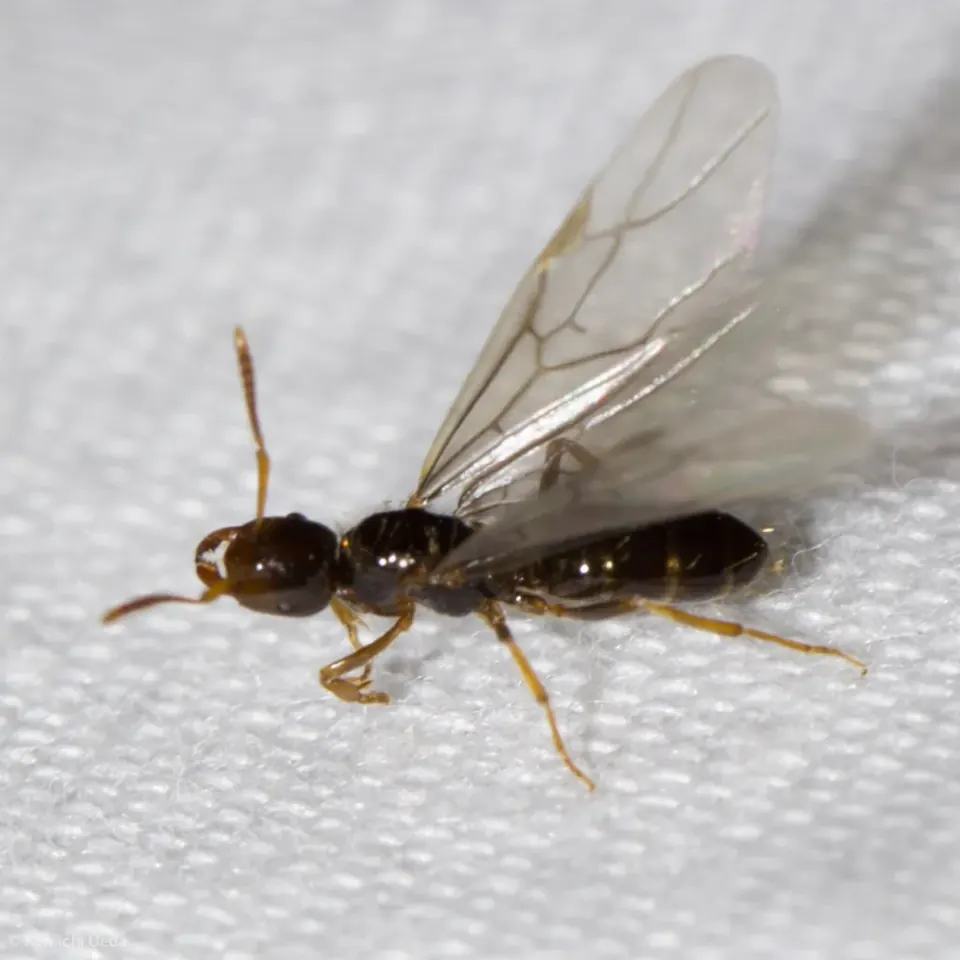
Wing surface and color narrow the group further
After the veins, the wing membrane gives a second check: subterranean termite wings look dull. Drywood wings have a reflective surface that the University of Hawaii compares to oil on water 1.
Within the subterranean termites, Formosan alates have small hairs covering the wings and body 22. Native Reticulitermes wings carry no hair and show a clear, net-like texture 15. The West Indian drywood termite, Cryptotermes brevis, has hairless but vividly iridescent wings 18.
Wing color varies within groups as well. The western drywood termite, Incisitermes minor, has dark wings with a smoky tint 19, while conehead termite alates have dark brown to black wings 23.
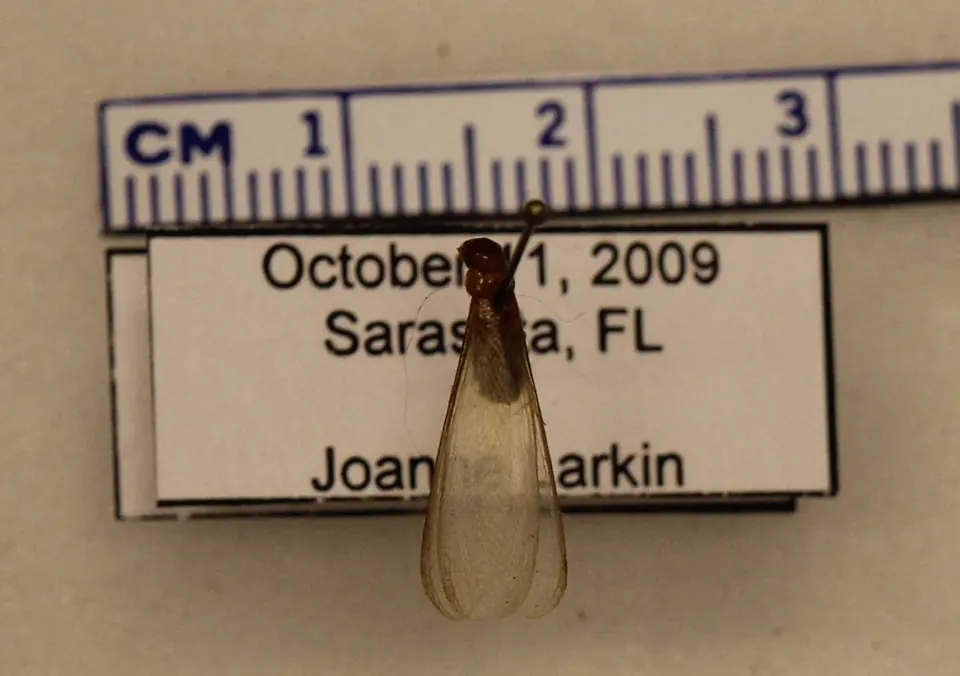
Shed wings still carry the vein pattern. NC State Extension suggests collecting the insects, or just their wings, from sills for identification 7. A single wing laid flat and photographed next to a ruler keeps both the veins and the size.
Soldier heads: the caste that confirms the group
Soldiers defend the colony with enlarged heads and jaws, and they cannot feed themselves, so workers feed them 24. Keys rely on soldiers and reproductives because their physical characters separate the species, while workers look much alike 4.
Formosan soldiers are about 4 to 5 mm long, with a brownish-orange teardrop-shaped head and dark curved mandibles 22. When disturbed, they exude a white, glue-like droplet from an opening on the forehead called the fontanelle 22. That droplet is a latex-like defense against small predators, not the concrete-dissolving acid of popular stories 2.
Reticulitermes soldiers have rectangular heads and mandibles curved at the tip in an S shape 15. In the western subterranean termite, R. hesperus, the head is about twice as long as it is wide 17.
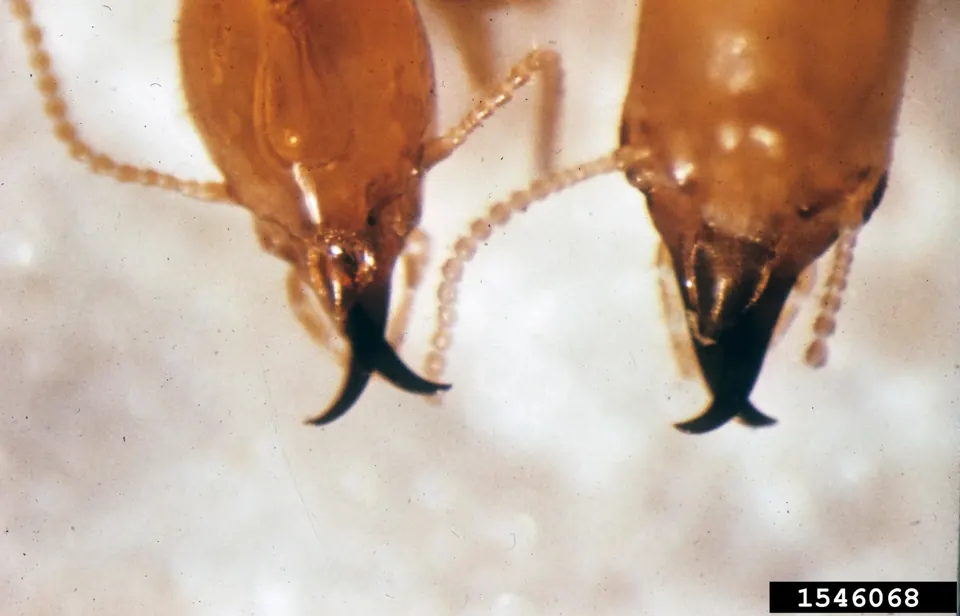
The number of soldiers is a field clue as well. When a tube or gallery is broken open, many soldiers rushing to the breach suggests Coptotermes, whose colonies are about 10 to 15 percent soldiers 22. Few or none suggests Reticulitermes, at 1 to 2 percent 15.
Western drywood soldiers are much larger, 8 to more than 12 mm, with a reddish-brown head and two teeth on the inner edge of the left mandible 19. The phragmotic drywood head is sometimes compared to a burnt matchstick 2.
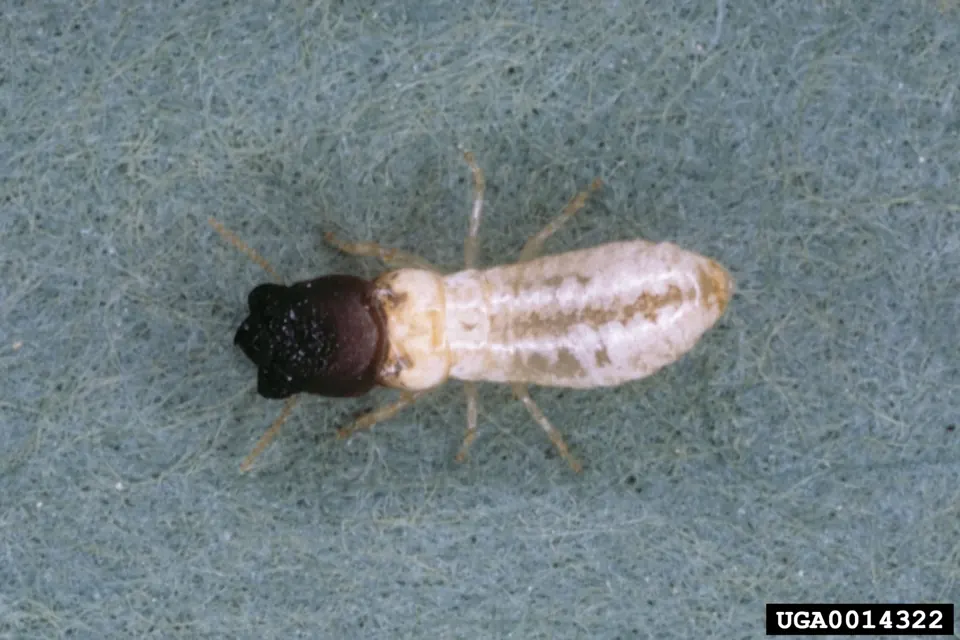
Conehead soldiers are recognizable on sight: about 5 mm long, they carry a cone-shaped projection called a nasus instead of large jaws 23. Pacific dampwood soldiers are giants by comparison, 15 to 20 mm long with black mandibles 17.
How the US termite groups differ in the field
Where the insect was found, and what it left behind, should agree with the group the key names.
Native subterranean termites
Reticulitermes species, the native subterranean termites, occur in every continental state except Alaska 15. They are most common in the warm, humid Southeast 15. Colonies live in soil and reach wood above ground through earthen shelter tubes about 1/4 to 1/2 inch wide 4. Their galleries follow the wood grain and are lined with mud or pale, spotted fecal material 24.
Formosan and Asian subterranean termites
The Formosan termite, Coptotermes formosanus, is largely restricted to the subtropical Southeast 15. They often build carton nests of chewed wood, saliva and feces inside walls 4. Mud tubes high on interior walls, ceilings or eaves usually point to Formosan termites 6.
Drywood termites
A drywood termite colony lives entirely within the wood, with no contact with soil, and infests lumber and furniture shielded from rain 18. The immature termites that do the colony's work push hard fecal pellets, hexagonal in cross section, out of kick-out holes about 1 to 2 mm across 18. Those droppings collect in small piles below the holes 18.
Dampwood termites
Dampwood termites need wet or decaying wood, do not tunnel through soil and do not build shelter tubes 17. Zootermopsis species live in the Pacific Northwest, while Neotermes species occur in Florida and coastal southwestern states 2. Washington State University describes the local dampwood swarmers as orange-brown and about 3/4 inch long with wings 25.
Conehead and desert termites
The conehead termite, Nasutitermes corniger, has been established in Broward County, Florida, since 2001 23. It builds conspicuous carton nests on trees and long, branched tunnels on walls 23.
In the desert Southwest, Gnathamitermes perplexus coats dead grass, fences and palm trunks with wide, thin earthen sheeting 26. University of Arizona Extension states that it is not a pest and should not be treated unless found inside a structure 26. The desert subterranean termite, Heterotermes aureus, is a structural pest there and drops small circular tubes from ceilings 9.
Time of day and season back up the key
Each group swarms on its own schedule, so the month and hour of a sighting can confirm or question the key's answer. Native subterranean termites usually swarm in daytime, often in spring after rain 7.
Formosan termites fly at dusk on warm, humid, windless evenings and are attracted to lights 27. In Louisiana their season runs from April through June, with a peak in early to mid May 27. The Asian subterranean termite flies at dusk or night, from February to April in Florida 28.
Western drywood termites fly during the day 19. Florida dampwood termites fly at dusk or night and come to lights 29. In Washington, dampwood termites swarm in late summer or fall, especially after rain 25.
Timing can support the key but not replace it, because subterranean termites can fly at any time of year, including winter in buildings with heated basements 4. A swarm of flying termites that emerges indoors usually means the building itself is infested 7.
Where a key stops and a lab takes over
Some species pairs cannot be separated by eye. Formosan and Asian subterranean soldiers differ in the hairs around the fontanelle, which needs a microscope 28. Heterotermes and Reticulitermes soldiers differ in mandible shape under magnification 30.
UF/IFAS states that termite identification usually requires a microscope or high-resolution camera, even for an experienced identifier 31. The same university reports that the vast majority of photos it receives lack the characters needed 2.
For a confirmed species, physical specimens work better than photos. Mississippi State's lab identifies insects at no charge and asks for several specimens in ethyl or isopropyl alcohol in a leak-proof bottle 5. The UF/IFAS termite identification service in Fort Lauderdale is also free 32. Many other states offer termite identification through Extension, usually for a nominal fee 2.
Why the group decides the treatment
Each group lives somewhere different, so each needs a different treatment. Soil termiticides, baits and physical barriers are tools for subterranean termites and do not apply to drywood termites 2.
For subterranean termites, the two main approaches in the US are non-repellent liquid termiticides and baits 15. Both must be applied by a licensed pest management provider 15. Drywood options are replacing the infested wood or item, spot treatment after a thorough inspection, or fumigation, which UF/IFAS rates as highly effective 2.
Dampwood termites often need no pesticide at all, because drying the infested area is usually enough to control them 2.
Once the group is known, the steps to get rid of termites narrow to the methods that fit it. A termite inspection confirms whether the colony is still active before any of the treatment options is chosen.
Questions
How do you identify a termite?
Check the antennae, the waist and the wings. A termite has straight, beaded antennae, no pinched waist and four wings of about the same size 1.
Which termite caste is easiest to identify?
Winged swarmers are the most useful, followed by soldiers. Workers are the hardest caste to identify 2.
Can termites be identified from a photo?
A sharp photo can usually separate a termite from an ant, and often one termite group from another. Naming the species usually needs a microscope or a high-resolution camera, even for an experienced identifier 31.
Are termites white ants?
No. Termites are sometimes called white ants, but they are more closely related to cockroaches than to ants 9.
Sources
- University of Hawaii at Manoa, CTAHR, Dept. of Plant and Environmental Protection Sciences. UH Termite Project, Alate Project: Identification Guide. Year not stated. manoa.hawaii.edu
- Oi, F. M., J. Davis, J. McConnell, J. Corbus, N. Nelson, and M. Atkinson. Termite Prevention and Control. UF/IFAS Extension ENY-2044 (IN1277). Original March 2020; revised December 2023. ask.ifas.ufl.edu
- Mississippi State University Extension Service, Dept. of Entomology. Are These Termites or Ants? Year not stated. extension.msstate.edu
- Peterson, C., T. L. Wagner, J. E. Mulrooney, and T. G. Shelton. Subterranean Termites: Their Prevention and Control in Buildings. USDA Forest Service, Home and Garden Bulletin 64. Revised October 2006. research.fs.usda.gov
- Mississippi State University Extension Service. Insect Identification Service (termites). Year not stated. extension.msstate.edu
- Mississippi State University Extension Service, Dept. of Entomology. Signs of Termite Infestation. Year not stated. extension.msstate.edu
- Crawley, S., and C. C. Hayes. Termite Swarmers: What Do They Mean for You? NC State Extension Publications. Published Dec. 1, 2009; reviewed/revised Feb. 24, 2023. content.ces.ncsu.edu
- LSU AgCenter, LSU Department of Entomology, and Louisiana State Arthropod Museum. Insect Identification Services. LSU AgCenter Publication 1838. Year not stated. www.lsuagcenter.com
- Baker, P. B., and R. J. Marchosky, Jr. Arizona Termites of Economic Importance. University of Arizona Cooperative Extension AZ1369. June 2005. extension.arizona.edu
- NC State University, ENT 425 General Entomology. Order Coleoptera (course web page). Year not stated. genent.cals.ncsu.edu
- Lewis, V. R., and S. J. Seybold. Pest Notes: Wood-Boring Beetles in Homes. UC ANR Publication 7418. UC Statewide IPM Program. Updated 06/2010. ipm.ucanr.edu
- University of Maryland Extension, Home and Garden Information Center. Ants and Termites: How to Tell the Difference. Updated October 17, 2024. extension.umd.edu
- Colorado State University. Colorado Insects of Interest: Booklice (fact sheet). Year not stated. webdoc.agsci.colostate.edu
- Gibb, T. J. Finding Winged Termites Is a Red Flag. Purdue Extension Hot News HN-61-W. Dated 5/15/2009. extension.entm.purdue.edu
- Chouvenc, T., N.-Y. Su, and R. H. Scheffrahn. Native Subterranean Termites: Reticulitermes flavipes, R. virginicus, R. hageni. UF/IFAS EDIS EENY-212 (IN369). Original May 2004; revised July 2024. doi:10.32473/edis-in369-2001. ask.ifas.ufl.edu
- Gold, R. E., M. Keck, E. Brown, and K. Schofield. Formosan Subterranean Termites. Texas AgriLife Extension Service, E-367 (dated 9/10). extensionentomology.tamu.edu
- Cannings, R. A., and G. G. E. Scudder. Families of Isoptera of British Columbia. In: Klinkenberg, B. (ed.) 2023. E-Fauna BC: Electronic Atlas of the Fauna of British Columbia. Dept. of Geography, University of British Columbia. linnet.geog.ubc.ca
- Gordon, J. M., R. H. Scheffrahn, and N.-Y. Su. West Indian Drywood Termite, Cryptotermes brevis. UF/IFAS EDIS EENY-79 (IN236). Original April 1999; revised December 2025. doi:10.32473/EDIS-in236-2020. ask.ifas.ufl.edu
- Cabrera, B. J., and R. H. Scheffrahn. Western Drywood Termite, Incisitermes minor. UF/IFAS EDIS EENY248 (IN526). Original November 2001; revised December 2005; reviewed February 2021. ask.ifas.ufl.edu
- Collins, L., and R. H. Scheffrahn. Red Imported Fire Ant, Solenopsis invicta. UF/IFAS EDIS EENY-195 (IN352). Original January 2001; revised November 2013; reviewed May 2020. ask.ifas.ufl.edu
- Morgan, A., D. Ring, L. Mao, et al. The Identification of Formosan Subterranean Termites. LSU AgCenter Pub. 2841 (dated 3/06). Additional authors not fully extracted. www.lsuagcenter.com
- Su, N.-Y., R. H. Scheffrahn, J. Gordon, and T. Chouvenc. Formosan Subterranean Termite, Coptotermes formosanus. UF/IFAS EDIS EENY121 (IN278). Original January 2000; revised September 2025. ask.ifas.ufl.edu
- Tong, R. L., K. E. Tenn, and R. H. Scheffrahn. Conehead Termite, Nasutitermes corniger. UF/IFAS EDIS EENY-745 (IN1275). Original December 2019. ask.ifas.ufl.edu
- Texas A&M University, Urban and Structural Entomology Program. Native Subterranean Termites, Reticulitermes sp. (web page). Year not stated. urbanentomology.tamu.edu
- Washington State University, Pestsense. Termites (fact sheet). Year not stated. pestsense.cahnrs.wsu.edu
- Baker, P. Termite Management for Homeowners. University of Arizona Cooperative Extension AZ1356 (dated 3/2005). extension.arizona.edu
- Sun, Q. Preparing for the Termite Swarms. LSU AgCenter. Published April 20, 2026. www.lsuagcenter.com
- Scheffrahn, R. H., and N.-Y. Su. Asian Subterranean Termite, Coptotermes gestroi (=havilandi). UF/IFAS EDIS EENY128 (IN285). Original April 2000; revised April 2005; reviewed February 2021. ask.ifas.ufl.edu
- Scheffrahn, R. H., and N.-Y. Su. Florida Dampwood Termites, Neotermes castaneus, N. jouteli, and N. luykxi. UF/IFAS EDIS EENY122 (IN279). Original January 2000; revised December 2005; reviewed February 2021. ask.ifas.ufl.edu
- Scheffrahn, R. H., and N.-Y. Su. West Indian Subterranean Termite, Heterotermes sp. UF/IFAS EDIS EENY127 (IN284). Original April 2000; revised December 2005; reviewed February 2021. ask.ifas.ufl.edu
- Chouvenc, T., R. H. Scheffrahn, and L. Buss. Termite Species Distribution in Florida and UF Termite Identification Services. UF/IFAS EDIS ENY-2079 (IN1360). Original May 2022; reviewed February 2025. doi:10.32473/edis-IN1360-2022. ask.ifas.ufl.edu
- UF/IFAS Fort Lauderdale Research and Education Center. Send Samples (Termites in Florida). Last modified June 15, 2026. flrec.ifas.ufl.edu