Subterranean termites
Eastern, western, southern, arid land and desert species, with the evidence each leaves and the two professional treatments.
Subterranean termites nest in soil and reach wood through earthen tubes about 1/4 to 1/2 inch wide 1. They live in every state except Alaska and cause most termite damage in the United States 1. Signs include mud tubes on foundations, wood eaten along the grain with soil inside, and swarms of winged termites. Treatment is a professional liquid termiticide or a bait system 2.
In forests, woodlands and deserts, subterranean termites do useful work, feeding on felled trees, stumps, grasses and other dead plant material 3.
Under a house, the same habits make them the most widespread and damaging of the three main termite groups in the United States 1. A single eastern subterranean termite colony may contain 100,000 to 1,000,000 termites foraging up to 150 feet from the nest 2.
Perhaps the first sign was a thin line of dried mud climbing the foundation, or a few hundred winged insects in a bathroom one spring afternoon.
But the colony itself stays in the soil, out of sight. Treatment bids can differ in method, price and contract terms.
So how do you know the termites are still active, and which treatment fits your house?
We read the federal bulletin on subterranean termites and the extension guides from Florida to California to answer both.
Why the soil matters for your house
Soil gives these termites moisture, protection from predators and building material for their tubes 1. They travel through it to reach wood, then cross concrete or masonry inside earthen shelter tubes 1.
Most enter a building through wood that touches or sits close to the soil, particularly at porches, steps, terraces, fences and planters 1. A foundation crack as narrow as 0.03 inch (0.8 mm) is enough to let them through 1.
Slab-on-ground houses are among the most susceptible, because termites can reach the wood over the slab edge, through expansion joints and around plumbing 1.
Soil contact is not absolute: where condensation, roof leaks or plumbing leaks keep wood wet, subterranean termites can live above ground without returning to the soil 1.
Which subterranean termite do you have?
The native genus Reticulitermes causes most subterranean termite damage in the United States 1. From a management standpoint, calling a sample "native subterranean termites" is often enough, because treatment protocols are similar for all Reticulitermes species 2.
Eastern subterranean termite
The eastern subterranean termite (Reticulitermes flavipes) is the most widely distributed species, ranging across eastern North America from Ontario to Key Largo, Florida 2. Its swarmers are dark brown, almost black to the naked eye, and about 0.4 inch long including the wings 2.
Swarms come earlier in the South than in the North 1. In New England it usually runs from March to June 4. In Florida, flights run from early January to April 2.
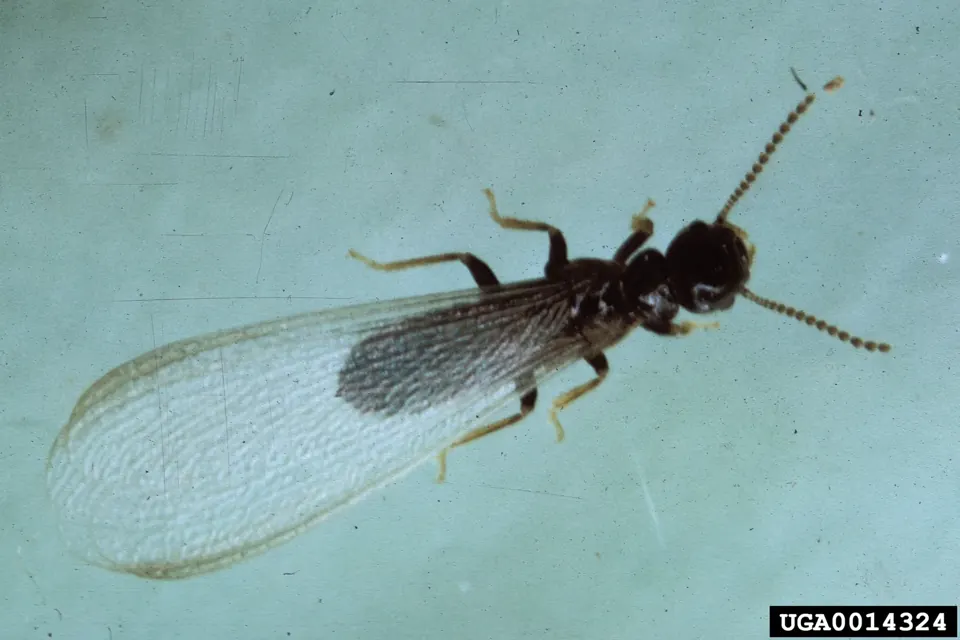
Dark and light southern subterranean termites
Two more species share the Southeast. The dark southern subterranean termite (R. virginicus) is dark brown like R. flavipes, while the light southern subterranean termite (R. hageni) is yellowish brown 2.
Both are smaller, about 0.3 inch long including the wings 2. In Florida, R. hageni flies in the evening from December to early February, which sets it apart from the afternoon flights of the other two 2.
Western and arid land subterranean termites
The western subterranean termite (R. hesperus) occurs along the Pacific Coast from southern California to British Columbia 2. In California it swarms in the afternoon, in spring or fall, on clear days after a soaking rain 3. In Oregon it may swarm at any time of year 5.
The arid land subterranean termite (R. tibialis) occupies the inter-mountain West 2. In Arizona it is the most widely distributed subterranean termite, flying in daylight on sunny days 6. It is less persistent at building tubes up to structures than other subterranean termites 6. Once inside a building, it favors moist, decaying wood over dry, sound lumber 6.
Desert subterranean termite
The desert subterranean termite (Heterotermes aureus) is the most destructive termite in Arizona 6. It ranges from southeastern California through southern Arizona into Mexico 6.
Because it tolerates heat and drought, it can attack dry, sound structural wood 6. Its tubes are small, strong and nearly airtight, lined with light yellow fecal plaster and often more than 24 inches high 6. Drop tubes hanging from a ceiling are a mark of this species 6. Its swarmers fly at dusk after monsoon rains, from July to September 6.
Formosan and Asian subterranean termites
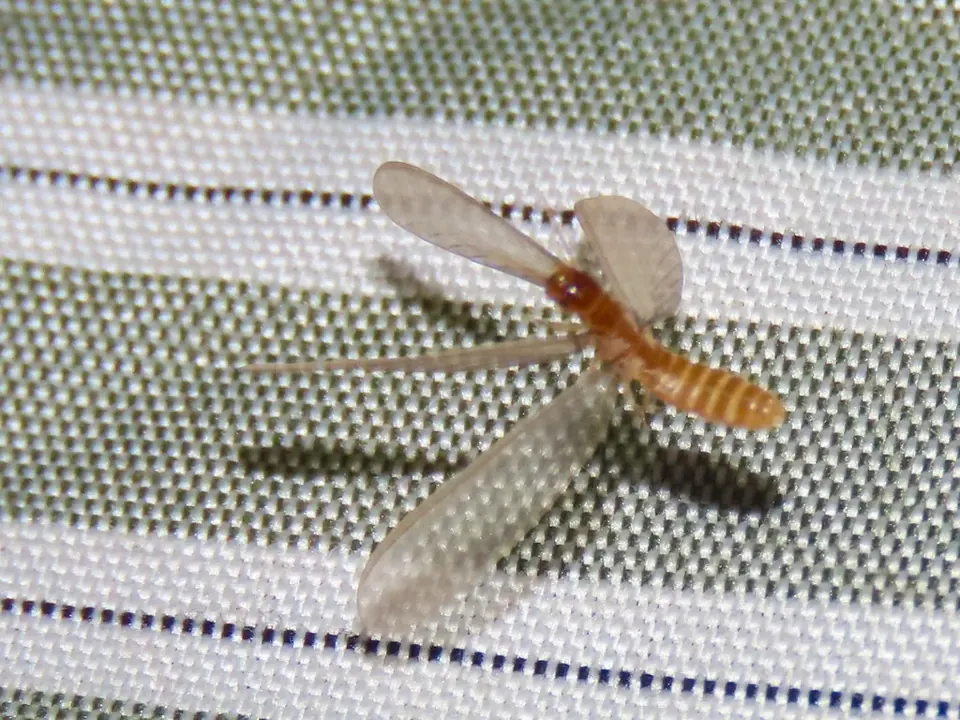
The invasive Formosan and Asian subterranean termites round out the group 78. Their soldiers have teardrop-shaped heads that release a white defensive secretion 7. Where moisture is available, a colony can build a carton nest inside a wall, with no need to return to the soil 9.
Reading the castes: workers, soldiers and swarmers
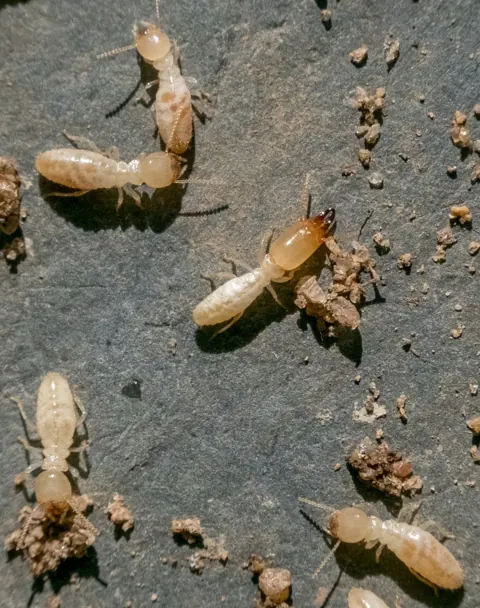
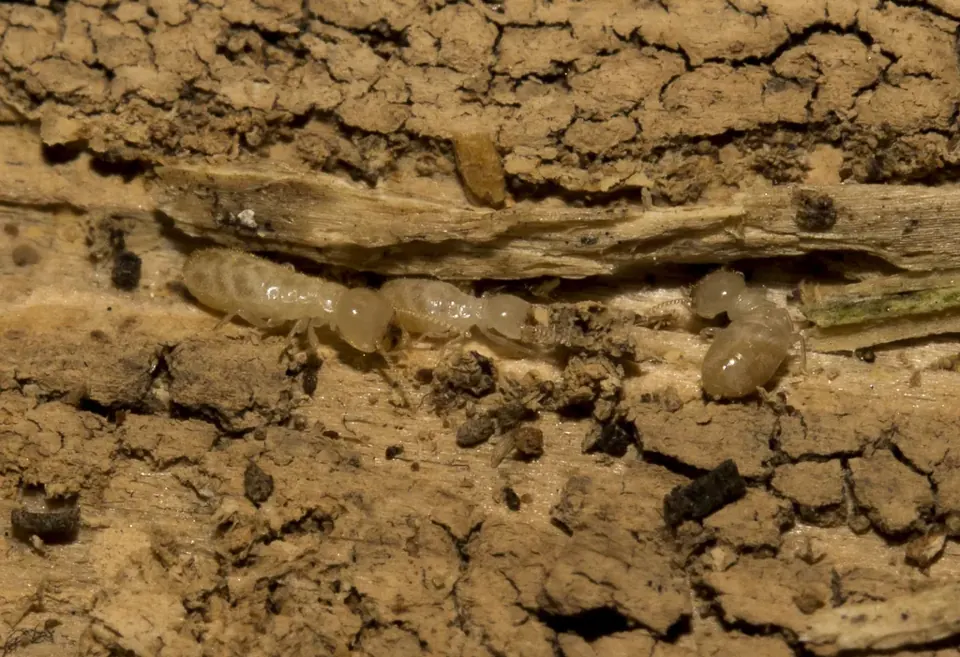
Workers are wingless, soft-bodied and white to yellowish white. They are the caste that eats the wood 1. They cannot be identified to species by looking at them, so extension labs ask for soldiers or swarmers 10.
Reticulitermes soldiers have rectangular heads with mandibles curved at the tip in an S shape 2. Soldiers make up only 1 to 2 percent of the colony, so few or none appear when a tube or gallery is broken open 2.
Swarmers carry two pairs of equal wings 1. Each wing has two hardened (sclerotized) veins along the front edge, no hairs and a fine, netted texture 2. After an indoor flight, Reticulitermes swarmers are usually found dead near windows, sinks or bathtubs, often with their wings still attached 2.
Is the infestation active? Tubes, damage and swarms
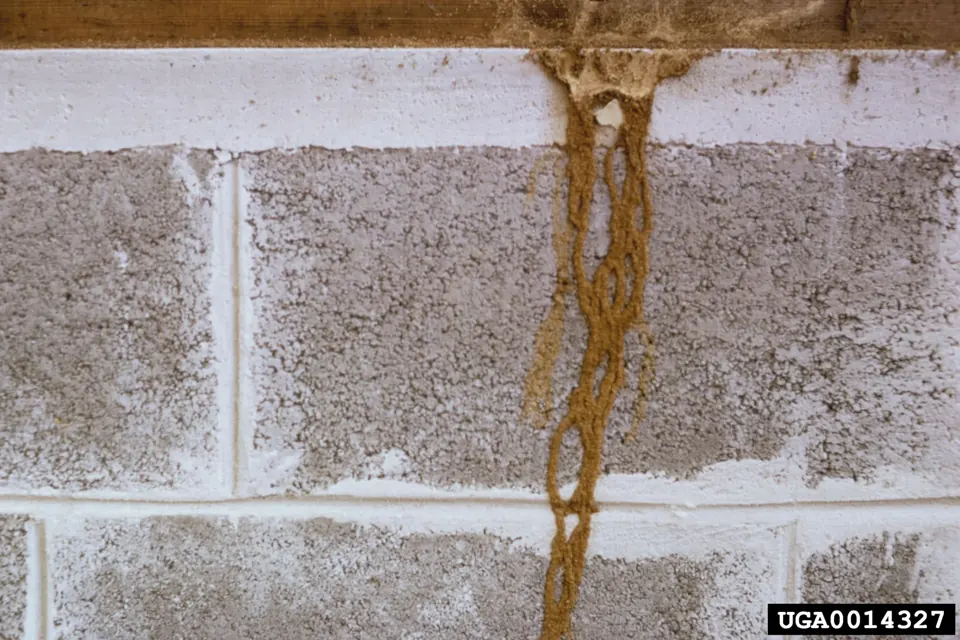
Earthen shelter tubes are the most commonly seen evidence of subterranean termites 3. They come in four types 3:
- working tubes, built from the nest in the soil up to wood;
- exploratory and migratory tubes, which rise from the soil but do not reach wood;
- drop tubes, which run from wood back down to the soil;
- swarm tubes, which winged termites use to leave during swarm season.
Breaking open about 1 inch of tube shows whether termites are inside 11. If none appear, a check several days later shows whether they have repaired the break or built new tubes 1.
An empty tube does not prove the colony is gone, because termites abandon tunnels and rebuild damaged ones 12. Breaking tubes does not control the termites either, so a professional inspection is worthwhile even when no termites appear 11. Old tubes dry, crumble and can leave an etching on the surface for years 12.
Subterranean termite damage follows the grain. The termites eat the softer springwood and leave the harder summerwood, a pattern that alone can often separate their work from other species 3. The galleries are often covered with yellow-brown or gray specks of excrement and soil 1.
They do not reduce wood to powder or push particles outside the way beetles and carpenter ants do 1. Badly damaged wood may sound hollow when tapped 1. Prodding with a screwdriver is a simple way to test its soundness 1.
Swarms are often the most obvious sign of a nearby colony 1. Indoor swarms usually mean an infestation somewhere in the house 13. Swarmers outdoors near stumps or yard timbers are not, by themselves, a sign that the house is infested 12.
Flights often come on the first warm days of spring after rain 1. In buildings with heated basements, termites occasionally swarm in winter 1.
Liquid termiticide or bait: how the professional treatments differ
The two primary ways to manage subterranean termites in the United States are non-repellent liquid termiticides and baits containing a chitin-synthesis inhibitor 2. Both must be applied by a licensed pest management provider 2.
Liquid soil treatment
A liquid treatment builds a chemical barrier between termites in the soil and the wood of the house 1. Applicators trench along the foundation and drill or rod through slabs and beside deep footings so the treated soil forms a continuous barrier 1.
Non-repellent products, such as those containing fipronil, imidacloprid or chlorantraniliprole, let termites enter treated soil, where they contact or ingest the termiticide 14. Soil treatments can last 2 to more than 15 years 14. They do not generally kill entire colonies 14. Soil disturbed by digging, pets or heavy rain may need retreatment 14.
Bait systems
Bait systems start with monitoring stations placed in the soil around the house 1. Once termites are found feeding, the toxic bait goes in and is shared through the colony 1.
The active ingredients in baits are insect growth regulators 14. Because they act slowly, control can take weeks, months or even years 1. Termite colonies can be eliminated with baits 14. Protection depends on the service contract: when it is cancelled and the bait is removed, protection ends 1.
What does not work, and what you can do
Fumigation, heat, freezing and electrocution devices do not control subterranean termites, because the reproductives and most of the colony are below ground 3. Do-it-yourself termite pesticides are generally not effective 3.
The timing is less urgent than it feels. Termites typically work slowly, so extreme haste is not required 1. The USDA Forest Service advises treatment within a few months of discovery 1.
Homeowners can make the house harder to attack while bids come in:
- Remove wood debris, form boards and buried scrap wood from under and around the house 1.
- Break wood-to-ground contact at piers, posts, stairs, attached fences and decks 14.
- Keep a 6-inch inspection gap between siding and the soil or mulch line 14.
- Fix leaks, direct air conditioner drain lines away from the house and aim irrigation heads away from walls 14.
- Keep shrubs and planters back from foundation walls so tubes stay visible 1.
Before signing, it pays to ask what evidence of activity the inspection found, which method the company proposes and why, and what the warranty excludes. In Florida, companies may exclude Formosan and Asian subterranean termites from contract warranties 14.
Questions
Can I get rid of subterranean termites myself?
It is rarely practical. Do-it-yourself termite pesticides are generally not effective 3. Most of the proven methods in California are for professional use only 3. Homeowners can still replace damaged wood and correct moisture and wood-to-soil contact 3.
How fast do subterranean termites damage a house?
Termites typically work slowly, so an infestation found during an inspection can usually be treated before the timbers are structurally weakened 1. The USDA Forest Service advises treating within a few months of discovery 1.
Do subterranean termites leave droppings?
They do not leave visible piles. Subterranean termites do not push wood particles or pellets out of the wood; their galleries carry specks of soil and excrement instead 1.
Is a bait system or a liquid treatment better?
Each has trade-offs. Liquid termiticides kill within hours or days and need no ongoing contract, while baits use far less chemical and spread through the colony but need weeks or months to work 1.
How long does a liquid termite treatment last?
UF/IFAS gives soil termiticides a longevity of about 2 to more than 15 years, depending on the product, the soil and whether the treated soil is disturbed 14.
Sources
- Peterson, C., T. L. Wagner, J. E. Mulrooney, and T. G. Shelton. Subterranean Termites: Their Prevention and Control in Buildings. USDA Forest Service, Home and Garden Bulletin 64. Revised October 2006. research.fs.usda.gov
- Chouvenc, T., N.-Y. Su, and R. H. Scheffrahn. Native Subterranean Termites: Reticulitermes flavipes, R. virginicus, R. hageni. UF/IFAS EDIS EENY-212 (IN369). Original May 2004; revised July 2024. doi:10.32473/edis-in369-2001. ask.ifas.ufl.edu
- Lewis, V. R., M. I. Haverty, and A. M. Sutherland. Pest Notes: Subterranean and Other Termites. UC ANR Publication 7415. UC Statewide IPM Program. Updated 05/2014. ipm.ucanr.edu
- Dugas, K. Eastern Subterranean Termite (Reticulitermes flavipes). Connecticut Agricultural Experiment Station fact sheet. Year not stated. portal.ct.gov
- Oregon State University Extension. Solve Pest Problems: Termites. Year not stated. solvepestproblems.oregonstate.edu
- Baker, P. B., and R. J. Marchosky, Jr. Arizona Termites of Economic Importance. University of Arizona Cooperative Extension AZ1369. June 2005. extension.arizona.edu
- Su, N.-Y., R. H. Scheffrahn, J. Gordon, and T. Chouvenc. Formosan Subterranean Termite, Coptotermes formosanus. UF/IFAS EDIS EENY121 (IN278). Original January 2000; revised September 2025. ask.ifas.ufl.edu
- Scheffrahn, R. H., and N.-Y. Su. Asian Subterranean Termite, Coptotermes gestroi (=havilandi). UF/IFAS EDIS EENY128 (IN285). Original April 2000; revised April 2005; reviewed February 2021. ask.ifas.ufl.edu
- Gold, R. E., M. Keck, E. Brown, and K. Schofield. Formosan Subterranean Termites. Texas AgriLife Extension Service, E-367 (dated 9/10). extensionentomology.tamu.edu
- Mississippi State University Extension Service. Insect Identification Service (termites). Year not stated. extension.msstate.edu
- Mississippi State University Extension Service, Dept. of Entomology. Signs of Termite Infestation. Year not stated. extension.msstate.edu
- Hayes, C. Monitoring and Management of Eastern Subterranean Termites. NC State Extension Publications. Publication date Jan. 22, 2025. content.ces.ncsu.edu
- Crawley, S., and C. C. Hayes. Termite Swarmers: What Do They Mean for You? NC State Extension Publications. Published Dec. 1, 2009; reviewed/revised Feb. 24, 2023. content.ces.ncsu.edu
- Oi, F. M., J. Davis, J. McConnell, J. Corbus, N. Nelson, and M. Atkinson. Termite Prevention and Control. UF/IFAS Extension ENY-2044 (IN1277). Original March 2020; revised December 2023. ask.ifas.ufl.edu