Free termite identification
Fees and submission steps exactly as each university program states them. Where a program lists no fee, this page says so.
Several university extension programs identify termites at no charge. The UF/IFAS termite ID team in Fort Lauderdale accepts samples from Florida and beyond at no cost 1, and Mississippi State's Extension Insect Identification Lab charges nothing 2. Send soldiers or winged swarmers, not only workers, packed in a crush-proof container 2. Mississippi State wants them in a leak-proof bottle of alcohol, while UF asks that no flammable liquid be mailed 1.
Many state extension services identify termites, usually for a fee that is nominal next to the cost of damage, and UF's termite researchers charge nothing 3. That team built its map of Florida species from more than 6,500 samples gathered over four decades by biological surveys, pest control companies, residents and extension offices 1.
The service matters because the species decides what happens next. UF termite researchers stress confirming the species before taking action, since termite treatments are target-specific and often mutually exclusive 1.
Maybe you have a few winged insects in a jar from the windowsill, or pale insects from a broken mud tube. You probably want a name before anyone quotes a treatment.
But UF/IFAS reports that the vast majority of photographs submitted for identification lack the characteristics needed to make one 3. Mailing the insects raises its own questions: which lab takes them, what it charges, and how to keep them from arriving crushed.
So where can you send a termite for free, and what should go in the vial? We checked the published submission pages of seven university programs for their stated fees and steps.
Why identifiers ask for the insect, not a photo
Termites are small, with species features that are hard to see. UF termite researchers report that identification usually requires a microscope or a high-resolution camera, even for an experienced identifier 1.
Insects are three-dimensional, Clemson University's extension service points out, so antennal segments, body hairs, mouthparts and wing veins blur in a photo with shallow depth of field 4. For a specific species such as the Formosan subterranean termite, Clemson suggests mailing the specimen 4.
The UF Insect Identification Lab gives free tentative identifications from photographs but cannot guarantee their accuracy 5. Louisiana's identification service says outright that submitting the insects themselves gives the most confident identification 6.
Some distinctions need a microscope in any case. Soldiers of the Formosan and Asian subterranean termites both have teardrop-shaped heads, and the diagnostic difference lies in the fine hairs beside the fontanelle, a pore on the head, which microscopic examination reveals 7.
Which termites to collect
Not every caste carries the features an identifier needs. UF/IFAS ranks winged swarmers (alates) as the most helpful, followed by soldiers, then workers 3.
Workers are the most numerous caste but the hardest to use. With a few exceptions, they are not reliable for species identification 1. Mississippi State's lab cannot identify workers to species and asks for samples that include soldiers, swarmers or both 2.
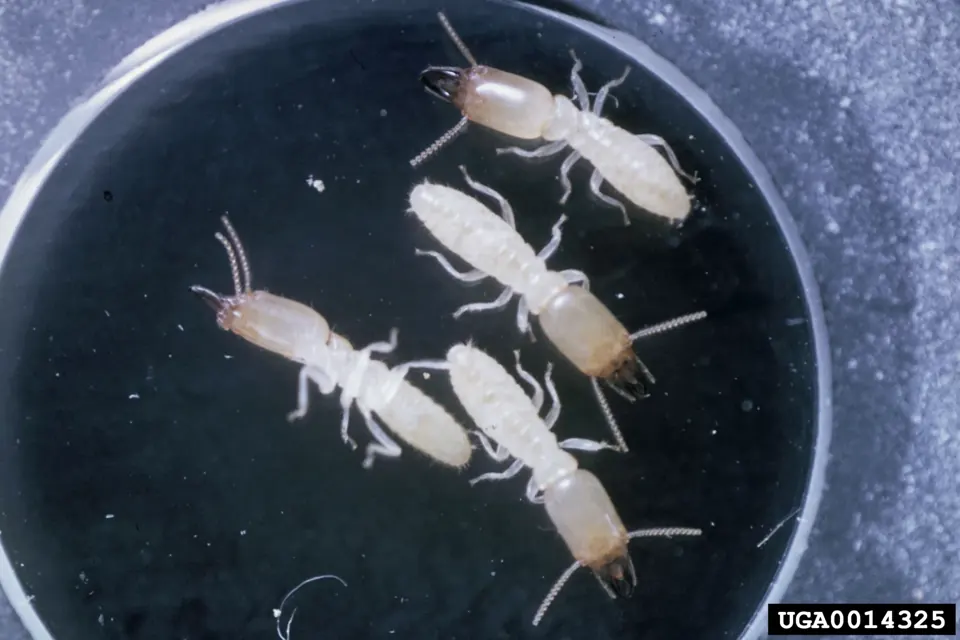
Where to find each caste:
- In a structure or a tree: collect from the active site and include the soldier caste if possible 8. Breaking open a tube can expose live workers and soldiers running through it 9.
- During a swarm: collect winged or dewinged adults. Many species are attracted to light at dusk during dispersal flights 8.
- After a swarm: wings left near windows can be collected and used for identification 10. NC State suggests saving the insects or their wings for a pest control service or extension specialist 11.
UF/IFAS asks for as many termites as you can collect 3. Clemson likewise advises including several specimens where possible 4.
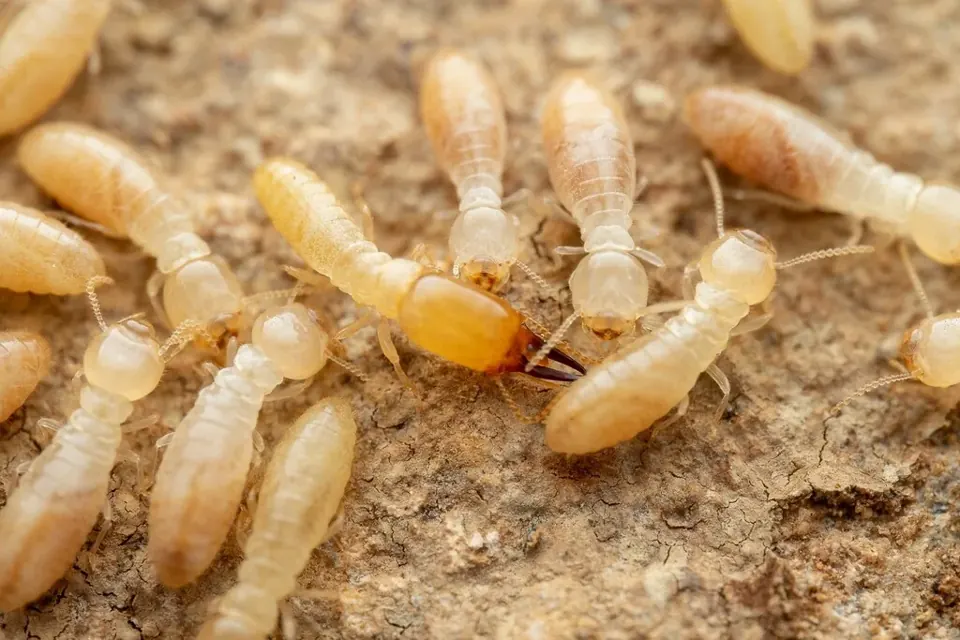
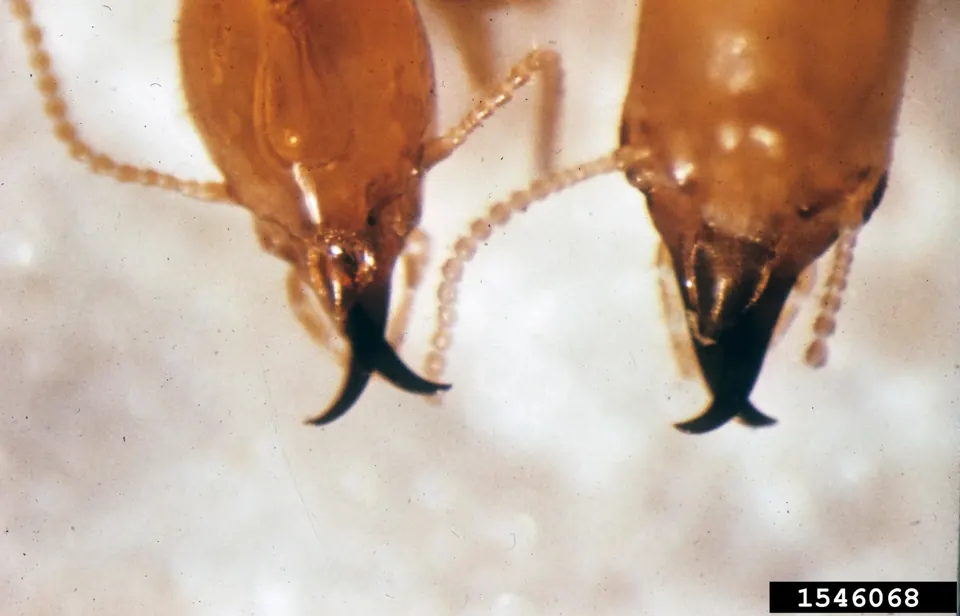
The soldier's head explains why soldiers matter so much. Its shape separates groups in the termite identification key: Texas A&M contrasts the teardrop-shaped head of the Formosan termite soldier with the more rectangular head of native subterranean termites 10.
How to preserve and pack a sample
These steps combine the instructions published by UF/IFAS, Mississippi State, Clemson and LSU:
- Preserve in alcohol unless the lab says otherwise. Clemson specifies 70 to 90 percent ethyl or isopropyl alcohol in a sealed jar 4, and Mississippi State rates ethyl alcohol best, with isopropyl also working 2. Do not use water 4.
- Check the lab's rule on liquids in the mail. Mississippi State takes the sample by mail in a leak-proof bottle of ethyl alcohol 2, and LSU asks you to name the fluid and pack it against leaks 6. The UF termite ID team asks that no flammable liquid be shipped 1, so for that lab the termites go in a sealed plastic bag instead 8.
- Kill them first if they travel dry. LSU suggests freezing insects in a sealed container for several hours, overnight if possible, because they can revive otherwise 6.
- Pad and box it. Wrap the bottle or bag in paper towels or other absorbent padding and place it in a crush-proof container 2. UF/IFAS warns that samples mailed in envelopes, even padded ones, often arrive crushed 3.
- Label the sample. Include your name, email, phone and the collection date. Add the address and where on the property you found the termites, such as a door frame or a wall stud 3.
- Add context. Clemson asks how heavy the infestation is, what damage you see, and which insecticide was used, if any 4.
The Fort Lauderdale center will not provide an identification without the address where the termite was found 8.
Labs that identify termites, and what they charge
Seven university programs publish their submission rules. Two state that identification is free, while the UF Insect Identification Lab charges $15 per physical sample 5. The other four do not list a fee.
Florida: UF/IFAS termite ID team, Fort Lauderdale
- Fee: free 8. Samples from Florida and beyond are accepted at no cost 1.
- What to send: termites with soldiers if possible, protected from crushing 8. The center accepts a sealed plastic bag, and the UF publication describing the service asks submitters to avoid flammable liquids when shipping 81.
- Information required: the collection address, the collection date and an email address. Results come back by email; no identification is given by phone 8.
- Address: Termite ID Team, Ft Lauderdale Research and Education Center, University of Florida IFAS, 3205 College Ave., Davie, FL 33314 8.
- Photos: the center runs a termite photo submission portal 8.
That publication also names the Insect ID Lab as an alternative route, with samples merged into the same termite collection 1.
Florida: UF Insect Identification Lab, Gainesville
- Fee: $15 per physical sample for Florida residents; free for Florida Cooperative Extension agents 5.
- Photos: tentative identifications from photographs are free, with no guarantee of accuracy 5.
- Payment: due before the report is released, by check, money order, credit card or Google Pay 5.
Mississippi: MSU Extension Insect Identification Lab
- Fee: "There is no charge for insect identifications" 2.
- What to send: several insects in a small leak-proof bottle of ethyl alcohol, with soldiers or swarmers included 2.
- Packing: absorbent padding and a crush-proof container, plus your contact information and details about the sample 2.
- Address: MSU Receiving Station, Attn: Extension Insect ID Lab 9775, 405 East Garrard Road, Starkville, MS 39759 2.
The same lab identifies other insect pests and gives control recommendations for them 2.
Louisiana: LSU AgCenter Insect Identification Services
- Fee: the publication does not list one 6.
- How to submit: send a photo or the specimen, with its data, to your parish extension agent. The agent forwards important specimens to the LSU Department of Entomology 6.
- Photo requirements: in focus, with a coin, pen or ruler for scale, plus the date, location and your contact details 6.
- Specimens: dead and in a sealed container. If it is in alcohol, state the fluid and package it against leaks 6.
- Address: Insect Identification Services, c/o Department of Entomology, LSAM, 404 Life Sciences Building, Louisiana State University, Baton Rouge, LA 70803 6.
During Formosan swarm season, LSU also accepts swarmers or their wings through the Department of Entomology or a local AgCenter extension office 12.
Texas: Texas A&M Center for Urban and Structural Entomology
- Fee: the Texas A&M bulletin does not list one 10.
- What to send: soldiers or winged reproductives, the castes used for identification 10.
- Address: Center for Urban and Structural Entomology, 2143 TAMU, Department of Entomology, College Station, TX 77843-2143; telephone (979) 845-5855 10. The bulletin dates from 2010, and the more recent UF/IFAS list of clinics points to Texas A&M's online ID help page 3.
South Carolina: Clemson University through county Extension offices
- Fee: the fact sheet does not list one 4.
- How to submit: county Extension offices explain collection and shipping and can submit samples for you 4.
- Preservative: 70 to 90 percent ethyl or isopropyl alcohol 4.
North Carolina: N.C. Cooperative Extension county centers
- Fee: the publication does not list one 11.
- How to submit: bring the specimens to your local county Extension center, where staff will help identify them 11.
Other states
For other states, UF/IFAS directs readers to their land-grant university's extension service and lists insect identification clinics at Auburn University, NC State, Texas A&M, UC Riverside, the University of Georgia, the University of New Hampshire and Virginia Tech 3. That list gives no fees, so each clinic's own page is the place to confirm them.
In Florida, a suspected conehead termite is a reporting matter as well as an identification one. UF/IFAS asks residents to report it to the Florida Department of Agriculture and Consumer Services 3.
Photos as a fast first step
A photo can still move things along, because Clemson notes that the species is not always needed to make a sound control recommendation 4.
Its guidelines call for a ruler or a coin beside the insect for scale, a contrasting background (light gray if in doubt) and lighting that shows true color. Close-ups should cover the top, bottom and head, with the base of the antennae, the eyes and the mouthparts in focus 4.
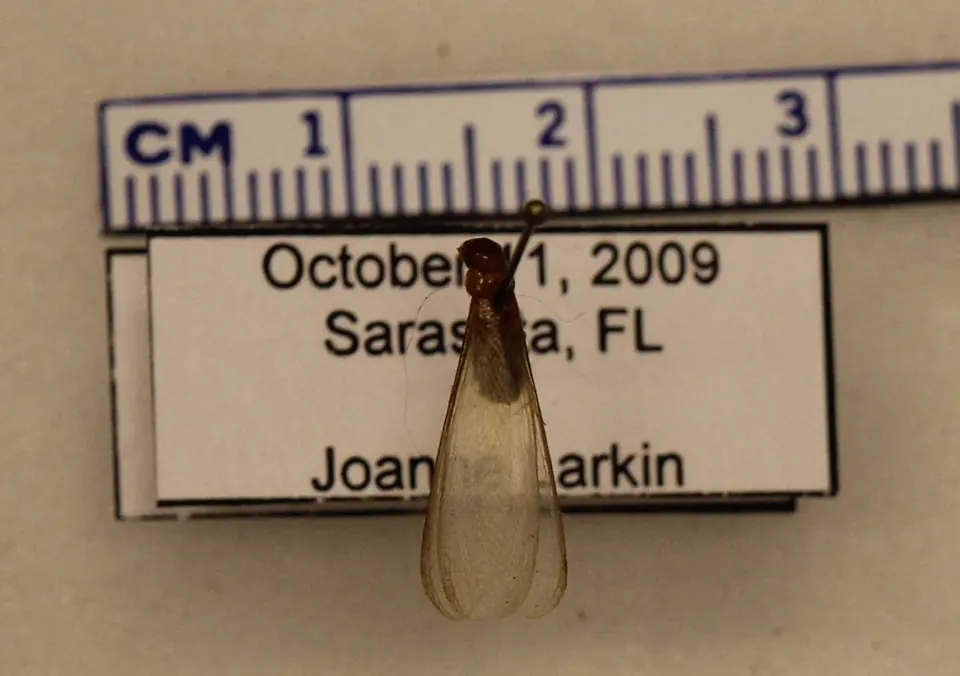
Images can work well for general identifications and for cases under time pressure, such as structural pests delaying a home sale 4.
The VTI test reads the antennae, waist, wings and body color in your photos, along with the shape of droppings and mud tubes. It also records how clearly each feature shows. When a photo cannot settle the species, the specimen goes to one of the labs above.
What the identification changes
A confirmed species can change the contract as well as the treatment. Some Texas termite contracts exclude Formosan termites, so the exact species should be known before a contract is signed 10. Florida allows companies to exclude Formosan and Asian subterranean termites from warranties 3.
Other results remove the need for treatment. In Arizona, the desert termite Gnathamitermes perplexus generally should not be treated unless it is found inside a structure 13.
With a name in hand, the next step follows from the group, whether that is a professional treatment, a moisture repair or no action at all.
Questions
Where can I get termites identified for free?
The UF/IFAS termite ID team at the Fort Lauderdale Research and Education Center identifies termite samples from Florida and beyond at no cost 1. Mississippi State's Extension Insect Identification Lab also charges nothing for identifications 2.
How do I preserve a termite sample?
Alcohol is the standard preservative: 70 to 90 percent ethyl or isopropyl alcohol in a tightly sealed container 4, with ethyl alcohol best 2. For a parcel to the UF termite ID team, which asks that no flammable liquid be shipped, the termites can go in a sealed plastic bag inside a small box instead 18.
Which termites should I send for identification?
Send soldiers or winged swarmers. Workers cannot be identified to species, so a sample of workers alone is not enough 21.
Can I email a photo of a termite for identification?
Some programs accept photos. The UF Insect Identification Lab gives free tentative identifications from photos but does not guarantee their accuracy 5. The Fort Lauderdale center runs a termite photo submission portal 8.
Sources
- Chouvenc, T., R. H. Scheffrahn, and L. Buss. Termite Species Distribution in Florida and UF Termite Identification Services. UF/IFAS EDIS ENY-2079 (IN1360). Original May 2022; reviewed February 2025. doi:10.32473/edis-IN1360-2022. ask.ifas.ufl.edu
- Mississippi State University Extension Service. Insect Identification Service (termites). Year not stated. extension.msstate.edu
- Oi, F. M., J. Davis, J. McConnell, J. Corbus, N. Nelson, and M. Atkinson. Termite Prevention and Control. UF/IFAS Extension ENY-2044 (IN1277). Original March 2020; revised December 2023. ask.ifas.ufl.edu
- Clemson University Home and Garden Information Center. Submitting Insect Samples for Identification (fact sheet). Year not stated. hgic.clemson.edu
- University of Florida Entomology and Nematology Dept., Insect Identification Lab. Services and Prices. Last modified July 29, 2024. entnemdept.ufl.edu
- LSU AgCenter, LSU Department of Entomology, and Louisiana State Arthropod Museum. Insect Identification Services. LSU AgCenter Publication 1838. Year not stated. www.lsuagcenter.com
- Scheffrahn, R. H., and N.-Y. Su. Asian Subterranean Termite, Coptotermes gestroi (=havilandi). UF/IFAS EDIS EENY128 (IN285). Original April 2000; revised April 2005; reviewed February 2021. ask.ifas.ufl.edu
- UF/IFAS Fort Lauderdale Research and Education Center. Send Samples (Termites in Florida). Last modified June 15, 2026. flrec.ifas.ufl.edu
- Lewis, V. R., M. I. Haverty, and A. M. Sutherland. Pest Notes: Subterranean and Other Termites. UC ANR Publication 7415. UC Statewide IPM Program. Updated 05/2014. ipm.ucanr.edu
- Gold, R. E., M. Keck, E. Brown, and K. Schofield. Formosan Subterranean Termites. Texas AgriLife Extension Service, E-367 (dated 9/10). extensionentomology.tamu.edu
- Crawley, S., and C. C. Hayes. Termite Swarmers: What Do They Mean for You? NC State Extension Publications. Published Dec. 1, 2009; reviewed/revised Feb. 24, 2023. content.ces.ncsu.edu
- Sun, Q. Preparing for the Termite Swarms. LSU AgCenter. Published April 20, 2026. www.lsuagcenter.com
- Baker, P. Termite Management for Homeowners. University of Arizona Cooperative Extension AZ1356 (dated 3/2005). extension.arizona.edu