Types of termites
Subterranean, drywood, dampwood, conehead and desert termites in the United States, sorted by the evidence each one leaves.
About 45 termite species live in the continental United States 1, grouped by where the colony nests. Subterranean termites live in soil and build mud tubes, drywood termites live inside dry wood and push out six-sided pellets, and dampwood termites need wet, decaying wood. South Florida's invasive conehead termite and the desert termites of the Southwest complete the list. Because each group nests differently, each needs a different treatment.
In forests, woodlands and deserts, termites break down woody debris, return its nutrients to the soil and feed a variety of predators 2.
The same appetite for cellulose turns a minority of species into structural pests. Subterranean termites alone account for about 80 percent of the estimated economic impact of termites 3.
If you have found wings on a windowsill or a scatter of hard grains under a door frame, the first question is what left them.
But "termite" covers insects that nest in soil, in dry rafters and in rotting logs. Each group lives by different rules, so a treatment chosen for the wrong one can cost money and leave the colony untouched.
So which kind do you have, and how sure do you need to be before anyone treats the house?
We read the extension and federal publications from each region where these termites live to answer that.
How many kinds of termites live in the United States?
Of the more than 2,600 termite species named worldwide, only 183 are known to damage buildings 1. About 45 occur in the continental United States, nearly 30 of them able to damage wood and wood products 1.
The federal literature sorts these species by where the colony lives: subterranean, drywood or dampwood 4. Species vary by region, but the groups and their control methods are recognized nationally 3.
The conehead termite, an invasive tree-nesting species, adds a fourth group in south Florida 5. In Arizona and neighboring states, desert termites feed mostly on dead grass, shrubs and weathered wood 1.
Family names have shifted in recent years. A 2024 genomic study placed Reticulitermes, Coptotermes and Heterotermes in the family Heterotermitidae 6. Older guides that call these genera Rhinotermitidae describe the same insects 7.
Drywood termites belong to the Kalotermitidae 8. The western dampwood genus Zootermopsis is an archotermopsid 6. Conehead and desert termites belong to the Termitidae 51.
The grouping matters because termite treatments are target-specific and often mutually exclusive 9. Depending on the species, the right response can be no action, removal of the infested wood, structural fumigation, bait or a liquid soil treatment 9.
Subterranean termites, the soil-dwelling group behind most damage
Subterranean termites nest in the soil, which keeps them moist and shields them from predators 4. To reach wood above ground, workers build earthen shelter tubes, usually about 1/4 to 1/2 inch wide, over the surface of foundation walls 4.
They occur in every state except Alaska and are most common in the South 4. Most US damage comes from the native genus Reticulitermes 4.
That genus includes the eastern subterranean termite (Reticulitermes flavipes), the western subterranean termite (R. hesperus) and the arid land subterranean termite (R. tibialis) 10. The Southeast adds the dark southern (R. virginicus) and light southern (R. hageni) subterranean termites 7.
Two invasive Coptotermes species belong to the same group. The Formosan subterranean termite came from Taiwan and southern China 11. Its close relative, the Asian subterranean termite, is established in south Florida 9.
In the Sonoran Desert, the desert subterranean termite (Heterotermes aureus) is the most common subterranean species and the most destructive termite in Arizona 1.
Subterranean damage follows the grain of the wood. The termites eat the softer springwood and leave the harder summerwood behind 2. Soil and gray-brown specks of excrement line the galleries 4.
They do not push pellets or wood particles out of the wood 4. The lack of pellets is one of the quickest ways to tell their damage from drywood damage.
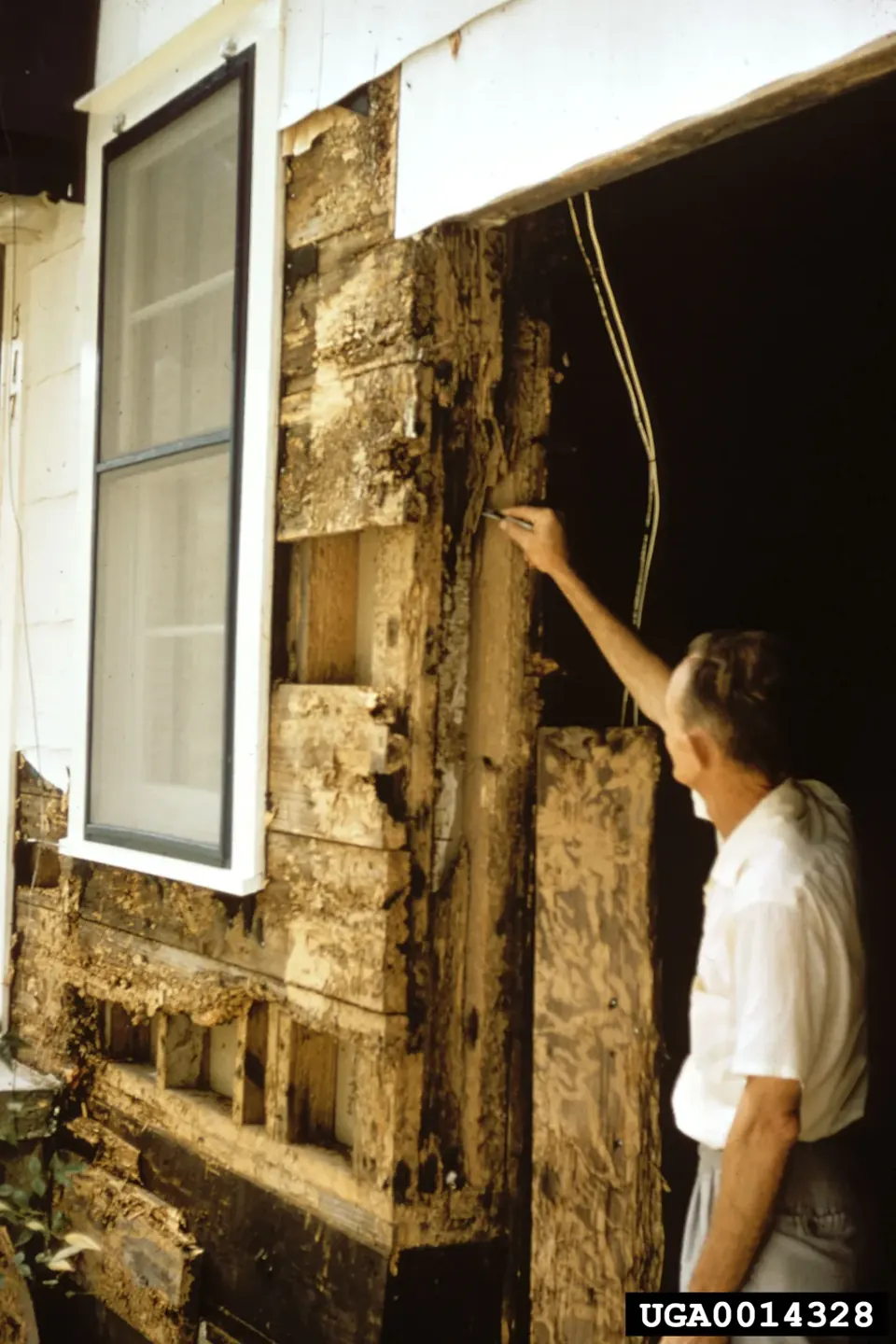
Drywood termites live entirely inside the wood they eat
Colonies of drywood termites never touch the ground. They live within sound, dry wood and get their water from the wood itself or from their own metabolism 8.
Their US range follows the warm edges of the country 4. It runs from the Atlantic states south of Virginia through Florida and the Gulf Coast to the Mexican border 4. On the Pacific Coast it reaches just north of San Francisco 4.
The western drywood termite (Incisitermes minor) is the most common structure-infesting drywood termite in the Southwest 8. In Florida, the West Indian drywood termite (Cryptotermes brevis) holds that position 8.
Workers push hard fecal pellets out through kick-out holes less than 2 mm across 13. Each pellet has six flattened sides, a shape that is diagnostic for drywood termites 13.
The galleries cut across the grain in any direction instead of following it 14. Drywood termites are commonly found in furniture 3. Moving infested wood has carried the western species to isolated sites across the country 8.
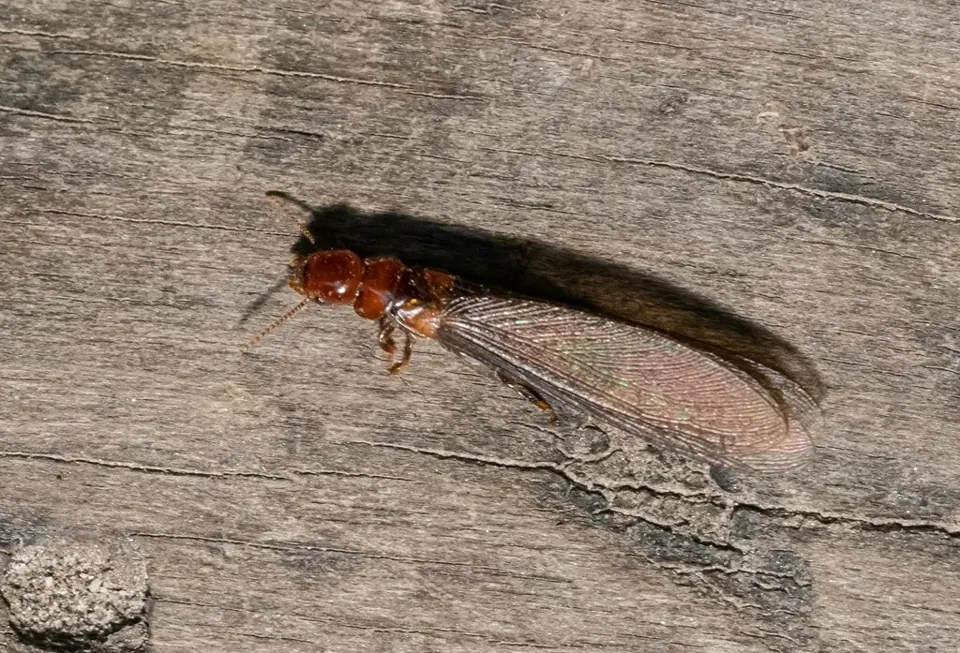
Not every drywood species is a house pest. Florida's light southeastern drywood termite lives mainly in dead tree branches and only casually infests outdoor wooden items 9.
Dampwood termites point to a water problem
Dampwood termites nest in moist, decaying wood, though they can extend tunnels into drier wood nearby 4. They are minor structural pests, limited to the Pacific Coast, the desert Southwest and southern Florida 4.
The West has two Zootermopsis species, the Pacific dampwood termite (Z. angusticollis) 10 and the Nevada dampwood termite (Z. nevadensis) 15. Florida has three Neotermes species, the largest termites in the eastern United States 16.
Size helps in the West: winged Pacific dampwood termites reach about 1 inch long, against 3/8 inch, wings included, for subterranean swarmers in the same region 17.
Because these termites need wet wood, an infestation signals a moisture problem or wood decay 2. Their pellets are rounded at both ends and lack the clear ridges of drywood pellets 13.
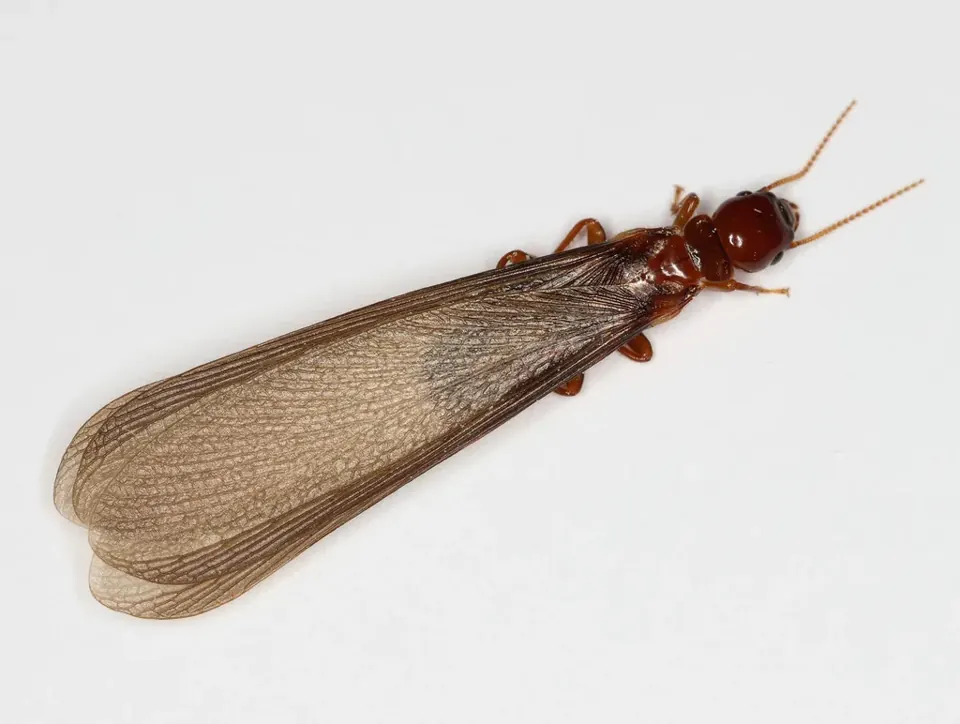
Conehead and desert termites: the two smaller groups
The conehead termite (Nasutitermes corniger) was the first non-native member of the family Termitidae found established in the United States, at Dania Beach, Florida, in 2001 5. Its soldiers carry a cone-shaped snout, the nasus, that releases a defensive secretion 5.
Colonies build conspicuous carton nests on trees, on the ground or on structures. Branching, straw-like tunnels connect the nests to feeding sites 5.
The Florida Department of Agriculture and Consumer Services leads an eradication effort for this species. UF/IFAS asks homeowners to report suspected conehead termites rather than treat them themselves 3.
Gnathamitermes perplexus, the tube-building desert termite, and Wheeler's desert termite (Amitermes wheeleri) are Termitidae of the arid Southwest 1.
G. perplexus coats dead grass, shrubs and fence posts with thin, flattened earthen tubes, then feeds on the weathered surface underneath 1. That damage is typically cosmetic 1. Chemical treatment is not necessary unless these termites turn up inside a structure 1.
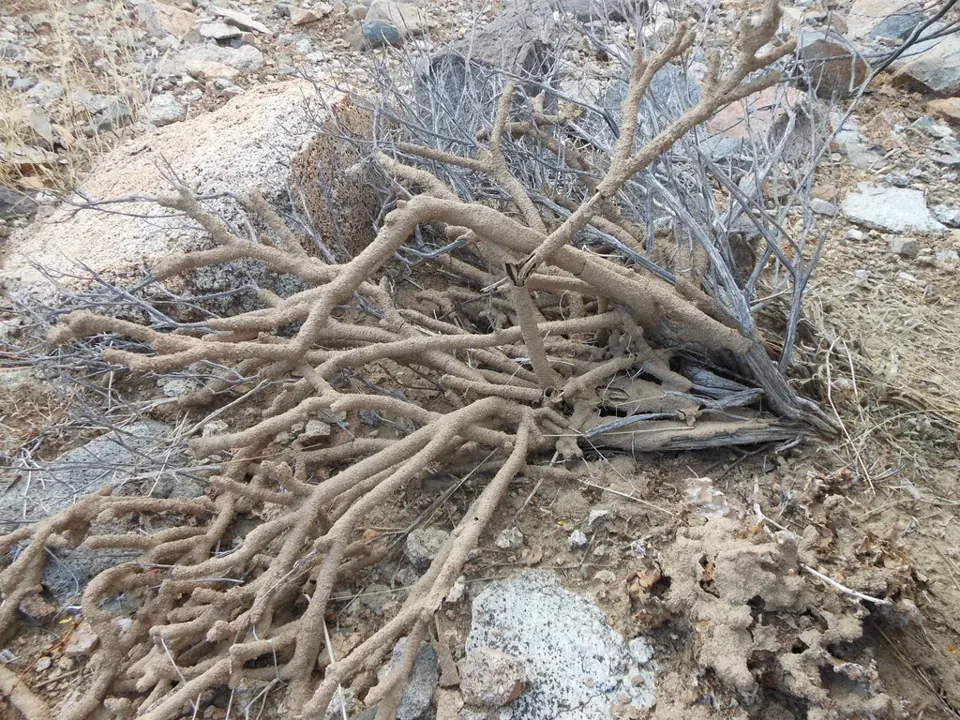
They are not the same insect as the desert subterranean termite described above, which attacks sound structural wood 1.
Colony size explains why the damage differs
A subterranean colony is a large, spread-out operation. One eastern subterranean termite colony may hold 100,000 to 1,000,000 termites and forage up to 150 feet for food 7. Formosan colonies can reach several million 9.
Drywood colonies are small by comparison, usually under 1,000 individuals 13. A western drywood colony may take five to seven years to produce visible feeding damage 8.
Florida's Neotermes dampwood colonies reach several thousand individuals 16. Conehead colonies can number from 800,000 to more than 1.2 million 5.
Drywood infestations are usually localized, often inside a single piece of wood 3. A subterranean colony's territory can cover anything from a few square feet to over an acre 3.
Which termites live in your region?
Where you live narrows the list of likely termites before anyone examines a specimen.
- Northeast and Midwest. The eastern subterranean termite is the main species, with a range that covers eastern North America north to Ontario 7. Drywood infestations here are isolated cases carried in with infested wood 8.
- Southeast and Gulf Coast. R. flavipes and R. virginicus occur throughout Florida, with R. hageni found less often 7. Formosan termites have spread through the southeastern states and north along the Atlantic coast to Virginia 11. Florida has 20 established termite species, the most of any mainland state 9. The largest West Indian drywood termite populations are in older buildings in the southern half of Florida 12.
- Texas. Homeowners in every part of the state are advised to watch for native subterranean termites 18. Formosan termites have been found in at least 30 counties 19. Three drywood species occur, most densely along the Gulf Coast 20.
- Desert Southwest. Arizona has 18 commonly found species 1. The arid land subterranean termite occurs statewide, while the desert subterranean termite keeps mainly to true desert below 4,000 feet 1. The two drywood pests are the western drywood termite and the light western drywood termite (Marginitermes hubbardi) 1.
- California. At least 23 species occur in the state 2. Reticulitermes species are the most destructive 2. The western drywood termite ranks second among the state's termite pests 13.
- Pacific Northwest. Pacific dampwood and western subterranean termites cause the structural damage; the western drywood termite is uncommon 17.
- Hawaii. All three main groups cause problems 4. The Formosan subterranean termite was first described there in the late 1800s 11. As in Florida, nearly all structural fumigation there targets the West Indian drywood termite 12.
Telling the groups apart from what you found
Workers are the caste you are most likely to see, but they cannot be identified to species 21. The evidence around them often narrows the group faster.
- Earthen tubes on a foundation, or soil packed into damaged wood. Subterranean termites 4. Tubes high on interior walls, ceilings or eaves usually point to Formosan termites 22.
- Small piles of hard, uniform, six-sided pellets on a floor or sill. Drywood termites 22. The kick-out holes above them are about the size of a pen tip 3.
- Large open galleries in wet or rotting wood, with rounded or clumped pellets. Dampwood termites 21316.
- A carton nest on a tree in south Florida, with straw-like tunnels running from it. Possible conehead termites 5.
- Thin earthen sheets over dead shrubs, grass or fence posts in the desert. Desert termites 1.
When the evidence is ambiguous, swarmers and soldiers can settle the group. On a shed forewing, drywood termites show three or more veins along the front margin, while Formosan termites show two 19. Subterranean wings look dull, while drywood wings look reflective, like oil on water 23.
The timing of a swarm is another clue. Native Reticulitermes swarmers usually fly in daylight, often on warm days after rain 24. Formosan termites fly at dusk and gather around lights 25.
Western drywood termites also fly by day, from late September through November in southern California 8. Pacific dampwood termites swarm in late summer or fall 17.
Soldiers separate the families by the plate behind the head, the pronotum. It is narrower than the head in subterranean termites and as wide or wider in drywood and Florida dampwood termites 7.
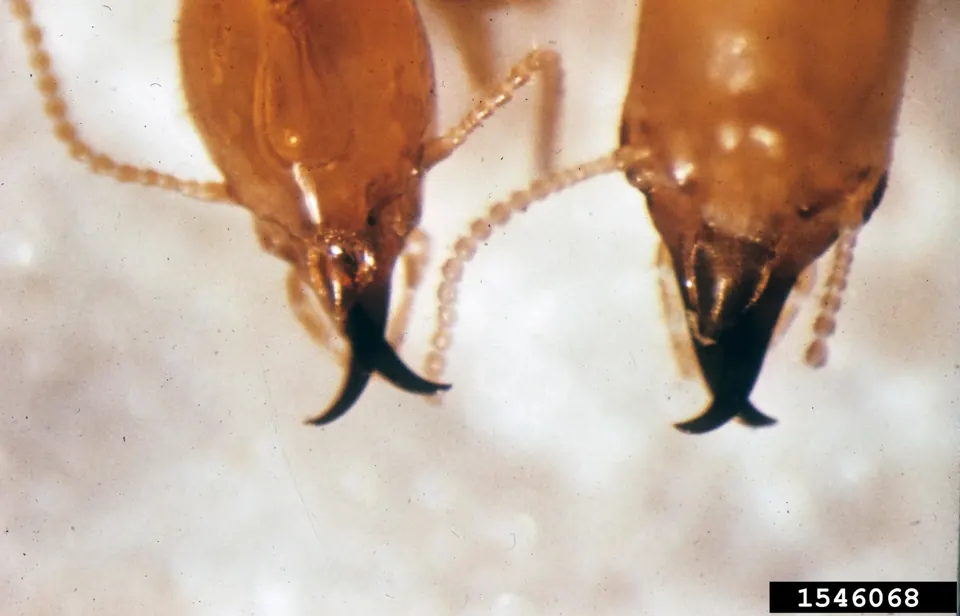
Within the subterranean group, Reticulitermes soldiers have rectangular heads, while Coptotermes soldiers have oval ones 7. For a confirmed species, identification usually requires a microscope or a high-resolution camera, even for an experienced identifier 9.
UF/IFAS treats species identification as the first step before any treatment, to limit the misuse of pesticides 9. Several extension labs identify termites free of charge from soldiers or swarmers preserved in alcohol 2126.
Why the group decides the treatment
Soil termiticides, bait systems and physical barriers are subterranean termite tools 3. None of them controls drywood termites, whose colonies never contact the soil 3.
The reverse also holds: fumigation, heat and electrocution cannot reach subterranean colonies, because the reproductives and most of the termites live near or below ground level 2.
For drywood termites, the choice is between a whole-structure treatment, which reaches every infestation in the building, and a localized one applied to a board or a few boards 13. Fumigation is highly effective against drywood termites 3, while spot treatment succeeds only after a thorough inspection has found the colonies 3.
Dampwood termites rarely need a pesticide. Drying the infested area is usually enough to control them, along with replacing damaged wood and fixing the moisture source 3.
Conehead colonies are treated with non-repellent liquid termiticide applied to their foraging tubes and feeding sites 5. Heavy structural infestations may need fumigation 5. Conehead termites do not respond to borates, so borate wood treatment in new construction does not protect against them on its own 3.
A licensed inspection comes before any treatment, whatever the group 2. Getting rid of an established colony of any structural group is generally not a do-it-yourself project 3. Termite pesticides sold for do-it-yourself use are generally not effective 2. Homeowners can still remove wood-to-ground contact, fix leaks and keep a 6-inch inspection gap between siding and soil or mulch 3.
Questions
How many types of termites are there in the US?
About 45 termite species occur in the continental United States, nearly 30 of which damage wood 1. The USDA Forest Service sorts them into three main groups by nesting habit: subterranean, drywood and dampwood 4.
What is the most destructive type of termite?
Subterranean termites are the most widespread and damaging group in the United States 4. Among single species, the Formosan subterranean termite is considered one of the most damaging pest termites in the world 11.
Can I tell termite types apart without a microscope?
Often at the group level, from evidence such as earthen tubes or six-sided pellets 413. Species identification usually needs a microscope or a high-resolution camera, which is why labs ask for soldiers or swarmers 9.
Sources
- Baker, P. B., and R. J. Marchosky, Jr. Arizona Termites of Economic Importance. University of Arizona Cooperative Extension AZ1369. June 2005. extension.arizona.edu
- Lewis, V. R., M. I. Haverty, and A. M. Sutherland. Pest Notes: Subterranean and Other Termites. UC ANR Publication 7415. UC Statewide IPM Program. Updated 05/2014. ipm.ucanr.edu
- Oi, F. M., J. Davis, J. McConnell, J. Corbus, N. Nelson, and M. Atkinson. Termite Prevention and Control. UF/IFAS Extension ENY-2044 (IN1277). Original March 2020; revised December 2023. ask.ifas.ufl.edu
- Peterson, C., T. L. Wagner, J. E. Mulrooney, and T. G. Shelton. Subterranean Termites: Their Prevention and Control in Buildings. USDA Forest Service, Home and Garden Bulletin 64. Revised October 2006. research.fs.usda.gov
- Tong, R. L., K. E. Tenn, and R. H. Scheffrahn. Conehead Termite, Nasutitermes corniger. UF/IFAS EDIS EENY-745 (IN1275). Original December 2019. ask.ifas.ufl.edu
- Hellemans, S., M. M. Rocha, M. Wang, et al. (46 authors). 2024. Genomic data provide insights into the classification of extant termites. Nature Communications 15. doi:10.1038/s41467-024-51028-y. www.nature.com
- Chouvenc, T., N.-Y. Su, and R. H. Scheffrahn. Native Subterranean Termites: Reticulitermes flavipes, R. virginicus, R. hageni. UF/IFAS EDIS EENY-212 (IN369). Original May 2004; revised July 2024. doi:10.32473/edis-in369-2001. ask.ifas.ufl.edu
- Cabrera, B. J., and R. H. Scheffrahn. Western Drywood Termite, Incisitermes minor. UF/IFAS EDIS EENY248 (IN526). Original November 2001; revised December 2005; reviewed February 2021. ask.ifas.ufl.edu
- Chouvenc, T., R. H. Scheffrahn, and L. Buss. Termite Species Distribution in Florida and UF Termite Identification Services. UF/IFAS EDIS ENY-2079 (IN1360). Original May 2022; reviewed February 2025. doi:10.32473/edis-IN1360-2022. ask.ifas.ufl.edu
- Entomological Society of America. Common Names of Insects Database (search 'termite'). Accessed 2026-11-29. entsoc.org
- Su, N.-Y., R. H. Scheffrahn, J. Gordon, and T. Chouvenc. Formosan Subterranean Termite, Coptotermes formosanus. UF/IFAS EDIS EENY121 (IN278). Original January 2000; revised September 2025. ask.ifas.ufl.edu
- Gordon, J. M., R. H. Scheffrahn, and N.-Y. Su. West Indian Drywood Termite, Cryptotermes brevis. UF/IFAS EDIS EENY-79 (IN236). Original April 1999; revised December 2025. doi:10.32473/EDIS-in236-2020. ask.ifas.ufl.edu
- Lewis, V. R., A. M. Sutherland, and M. I. Haverty. Pest Notes: Drywood Termites. UC ANR Publication 7440. UC Statewide IPM Program. Updated 08/2014. ipm.ucanr.edu
- University of Hawaii, CTAHR Termite Project. Drywood Termites vs. Subterranean Termites (public handout, PDF). Year not stated. www3.ctahr.hawaii.edu
- UC Statewide IPM Program. Image record I-IS-ZNEV-CO.001: Nevada dampwood termite, Zootermopsis nevadensis (worker, soldier, nymph, swarmer). Credit: Robin L. Tabuchi. Year not stated. ipm.ucanr.edu
- Scheffrahn, R. H., and N.-Y. Su. Florida Dampwood Termites, Neotermes castaneus, N. jouteli, and N. luykxi. UF/IFAS EDIS EENY122 (IN279). Original January 2000; revised December 2005; reviewed February 2021. ask.ifas.ufl.edu
- Oregon State University Extension. Solve Pest Problems: Termites. Year not stated. solvepestproblems.oregonstate.edu
- Texas A&M University, Urban and Structural Entomology Program. Native Subterranean Termites, Reticulitermes sp. (web page). Year not stated. urbanentomology.tamu.edu
- Gold, R. E., M. Keck, E. Brown, and K. Schofield. Formosan Subterranean Termites. Texas AgriLife Extension Service, E-367 (dated 9/10). extensionentomology.tamu.edu
- Texas A&M University, Urban and Structural Entomology Program. Drywood Termites (web page). Year not stated. urbanentomology.tamu.edu
- Mississippi State University Extension Service. Insect Identification Service (termites). Year not stated. extension.msstate.edu
- Mississippi State University Extension Service, Dept. of Entomology. Signs of Termite Infestation. Year not stated. extension.msstate.edu
- University of Hawaii at Manoa, CTAHR, Dept. of Plant and Environmental Protection Sciences. UH Termite Project, Alate Project: Identification Guide. Year not stated. manoa.hawaii.edu
- Hayes, C. Monitoring and Management of Eastern Subterranean Termites. NC State Extension Publications. Publication date Jan. 22, 2025. content.ces.ncsu.edu
- Sun, Q. Preparing for the Termite Swarms. LSU AgCenter. Published April 20, 2026. www.lsuagcenter.com
- UF/IFAS Fort Lauderdale Research and Education Center. Send Samples (Termites in Florida). Last modified June 15, 2026. flrec.ifas.ufl.edu