Formosan termites
The Formosan subterranean termite, Coptotermes formosanus, and its close relative the Asian subterranean termite.
The Formosan subterranean termite (Coptotermes formosanus) is an invasive termite native to Taiwan and southern China 1. Its soldiers have an orange, teardrop-shaped head that releases a white secretion 1. Swarmers are 12 to 15 mm long, orange to light amber-brown, and fly around dusk in late spring 12. Colonies can nest inside walls as well as in soil 3. Professionals treat them with non-repellent liquid termiticides or bait stations 1.
In their natural habitats termites are beneficial insects, breaking down dead and dying plant material and keeping its nutrients in circulation 3.
Human transport, including shipping, has carried the Formosan subterranean termite far beyond Taiwan and southern China 1. With colonies of several million termites 4, it is listed among the world's 100 worst invasive species 1. In the United States alone, its annual economic impact is likely more than $4 billion 1.
If you live near New Orleans, Houston or south Florida, you may have watched a cloud of winged termites circle a porch light on a warm May evening.
But a few swarmers at the window do not always mean the house is infested. A colony can also nest inside a wall, where a standard soil treatment does not reach it.
So how do you tell whether these are Formosan termites, and whether they are in your house?
We worked through the University of Florida, Texas A&M, LSU and Mississippi State publications on this species to answer both.
Where Formosan termites have spread
The first recorded introductions in the continental United States were in New Orleans, Charleston and Hallandale, Florida 1. Today the species is found in Hawaii and throughout the southeastern states, north along the Atlantic coast to Virginia and inland to Tennessee 1. On the West Coast it has been found in southern California 1, where it is restricted to a small area near San Diego 5.
Louisiana has it in 42 of its 64 parishes 2. In Texas, the first infestations were found in 1956 near the Houston Ship Channel 6. The species now occurs in at least 30 Texas counties 6.
Its movement has come largely from people moving wood products 3. Texas A&M considers infested shoring timbers and recycled railroad ties used in yards the primary way it spreads in Texas 6. Creosote treatment often does not reach the core of such timbers 6.
The Asian subterranean termite
A close relative, the Asian subterranean termite (Coptotermes gestroi), is a truly tropical species restricted to southern Florida 4. Life history, damage and management of the Formosan termite also apply to it 7.
Its swarmers are slightly smaller, with a dark brown head, pronotum and abdomen and two pale spots on the face 7. Its soldiers look like Formosan soldiers; separating the two takes a microscope to examine the hairs around the fontanelle 7.
In south Florida, the two species flew at the same time in 2013 to 2015 and mated in the field 8. The pairings produced vigorous hybrid colonies in the laboratory, but hybrid colonies have not been confirmed in the field 8.
What gives a Formosan soldier away?
Soldiers and winged swarmers are the castes used for identification 6. A Formosan soldier is about 4 to 5 mm long, with a white body, a brownish-orange teardrop-shaped head and dark, curved mandibles 1.
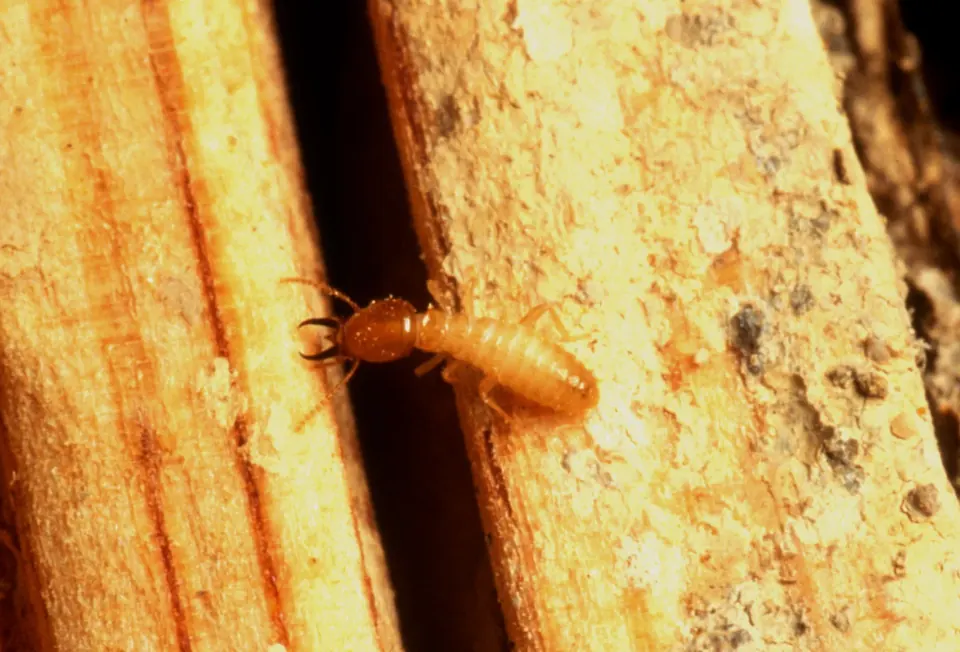
On the front of the head sits an opening called the fontanelle. When threatened, the soldier pushes out a white, glue-like secretion through it, which separates Coptotermes soldiers from native subterranean termites 1. Native Reticulitermes soldiers have a rectangular head instead 9.
Soldiers make up 10 to 15 percent of a Formosan colony, against 1 to 2 percent in native colonies 1. When a tube or gallery is broken open, many soldiers rushing to the breach point to Coptotermes; few or none point to Reticulitermes 9.
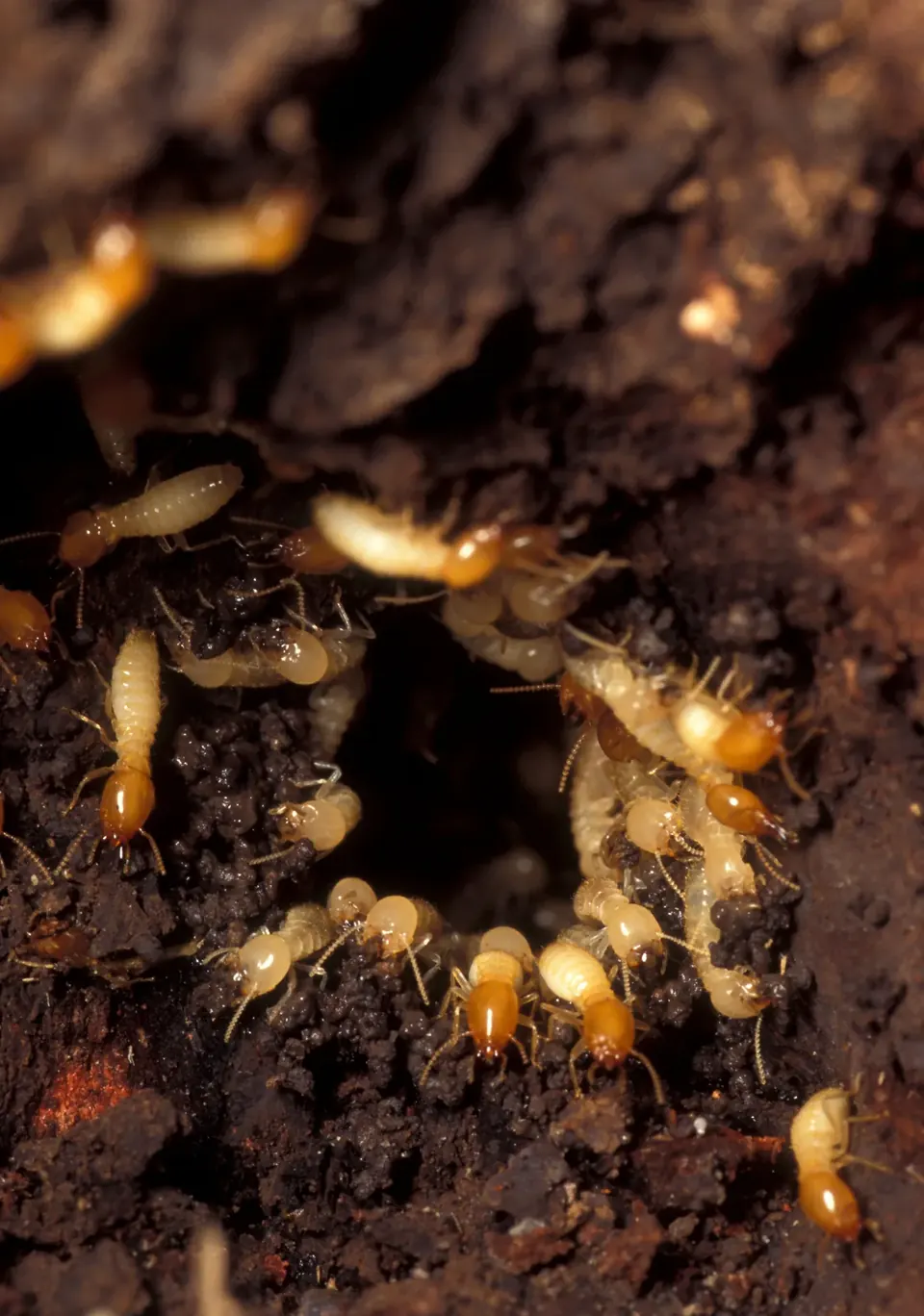
Soldiers can also clamp onto a finger with their mandibles. The bite and the fluid are harmless to people 6.
Swarms at dusk, drawn to lights
Formosan swarmers are larger and paler than native subterranean swarmers 10. They are 12 to 15 mm long and orange or light amber-brown 1. Their bodies and wings are covered in small hairs 1. Each wing has two darkened veins along the front margin with no cross veins between them 1.
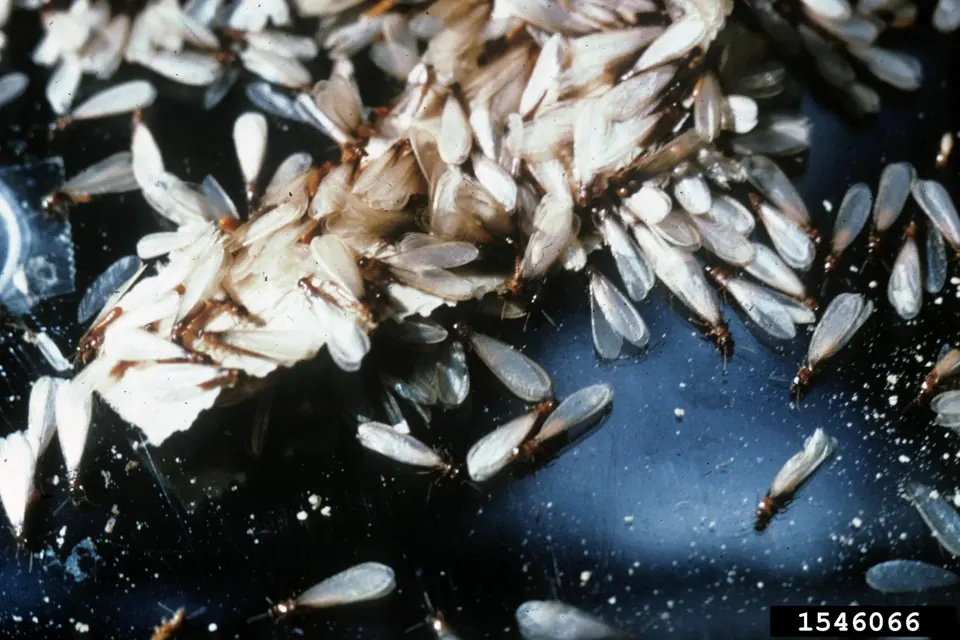
Timing is a strong clue. Native subterranean termites in Louisiana swarm during the day, while Formosan termites fly at dusk on warm, humid, windless evenings 2. In Florida they swarm between early April and late June, shortly after sunset, with a peak in May 1.
Texas swarms come at night from early May through June 6. In Mississippi the season runs from May to June 10.
Some drywood termites share the honey-brown color and size, but their wings are clear and hairless, with several cross veins between the outer veins 6.
Thousands of Formosan swarmers can hover around a single street light 2. They are weak fliers that usually travel no more than half a mile, so an outdoor swarm points to a colony in nearby trees or buildings 2.
What an indoor swarm means
Swarmers inside a house are a strong indication of an active infestation in that structure 6. The exception is a neighborhood heavily infested with Formosan termites, where a few dozen swarmers can drift into a properly treated house from outside 11.
Hundreds of Formosan swarmers indoors indicate a current problem, whatever the treatment history 11. Killing the swarmers does little, because the workers do the damage 2.
Collected swarmers or their shed wings can be identified by an entomologist 2. For a species-level answer, Clemson Extension notes that mailing the specimen may be more efficient than sending images 12. Several extension labs do this identification at no charge 1314.
Carton nests and colonies inside walls
Most US subterranean termite species do not build a clearly defined nest 3. The Formosan termite often builds carton nests inside walls 3.
Carton is a honeycombed mass of chewed wood, saliva and feces 3. Wall nests can reach several cubic feet and usually go undiscovered until the wall coverings are removed 6.
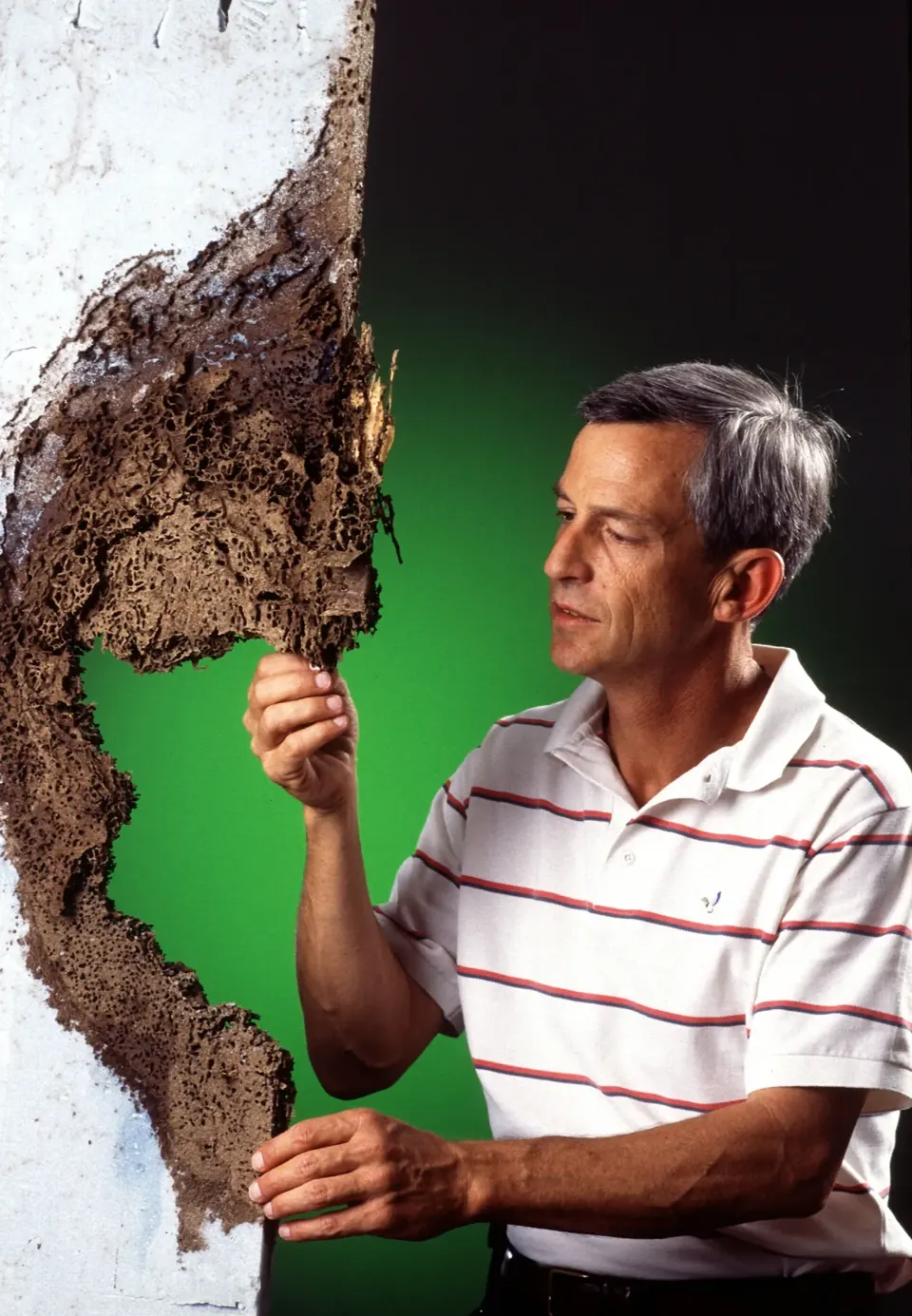
The carton holds moisture. With water available, Formosan termites can live for months or even years in an aerial nest while feeding on the structure above ground 6. If that colony is cut off from its underground nest, it can survive and keep damaging the building 6.
Several signs point to this kind of infestation:
- Tubes high on the building. Mud tubes on interior walls, ceilings, soffits or fascia boards are usually a sign of Formosan termites 11.
- Swarm castles. Odd-shaped formations of dried mud sprouting from walls or ceilings in late spring are probably built for swarming 11.
- Tubes through spray foam. Mud tubes running over or through foam insulation most often mean Formosan termites, though eastern subterranean termites can do the same 11.
- Damage in both wood layers. Formosan termites eat both the soft springwood and the harder summerwood, which makes them more destructive than native species 6.
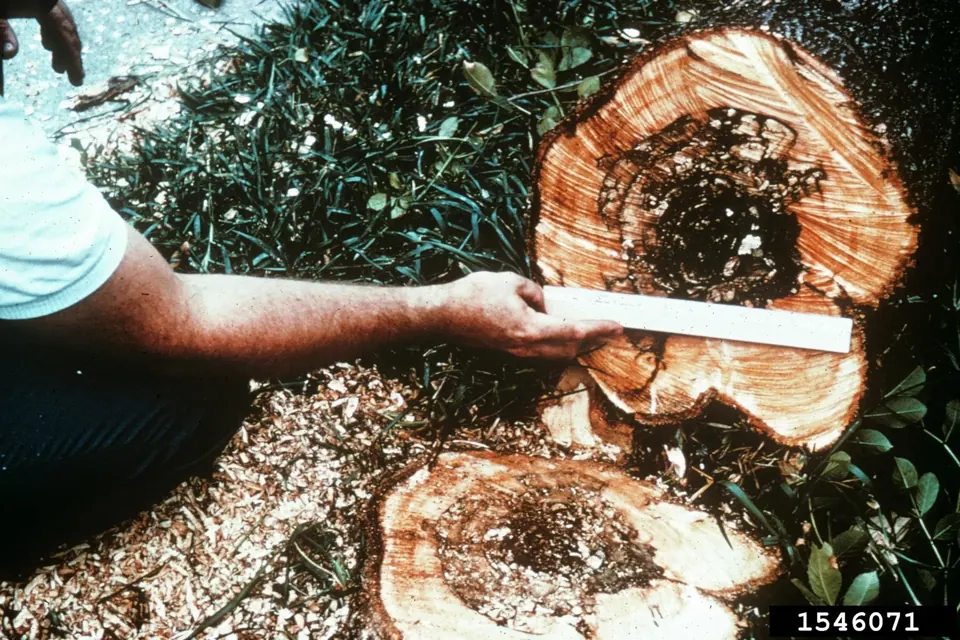
Trees are a second target. Formosan termites hollow out the dead center of living trees, which can weaken them enough to fall in high winds 1. Texas A&M reports attacks on more than 50 tree species, including pecan, citrus, sweet gum and white oak 6.
A popular myth says Formosan termites melt concrete with acid. The soldiers actually secrete a latex-like fluid for defense 15.
How Formosan infestations are treated
Control of Formosan termites requires professional pest control 1. Over-the-counter products are unlikely to work 1. Treatment is similar to that for other subterranean termites, though contracts may be written differently 15.
Non-repellent liquid termiticides
Applicators trench and treat the soil around the foundation or drill and inject through the slab 1. Liquid and foam formulations can also be injected into cracks, crevices and wall voids 1.
Properly applied, these products can protect the structure 1. They are unlikely to eliminate termite activity in the surrounding area 1.
Bait stations
In-ground stations hold a chitin-synthesis inhibitor that stops workers from molting 1. Once the workers die, the rest of the colony starves 1.
The process takes time: foragers have to find the stations, then every worker has to molt, which takes about three months 1. Above-ground stations can be fixed directly onto active sites in buildings and trees 1.
Aerial colonies, trees and contracts
Tubes on ceilings or upper floors can mean the colony lives in the building itself, kept alive by a leak or standing water 16. Such aerial infestations cannot be controlled with the usual soil treatment 16. Finding and fixing the moisture source comes first 16.
Infested trees can be treated by foaming the cavities with a registered termiticide, setting baits at the base or applying a labeled soil drench 15.
Contracts deserve a close read. Some states, including Florida, allow companies to exclude Formosan and Asian subterranean termites from warranties 15. Aerial infestations are also typically excluded from termite contract warranties 16.
Where Formosan termites are established, buildings need proper treatment and an annual inspection, whether or not they have ever been infested 11. Keeping tree branches off the roof removes a bridge the termites can use to reach the structure 15.
Questions
How can you tell a Formosan termite from a native subterranean termite?
Soldiers show the clearest difference. Formosan soldiers have an orange, teardrop-shaped head and release a white secretion when disturbed, while native Reticulitermes soldiers have rectangular heads 19. Formosan swarmers also fly at dusk toward lights, while native species swarm by day 2.
Can Formosan termites eat through concrete?
No. The story that they melt concrete with acid is a myth; the soldiers secrete a latex-like defensive fluid, not acid 15. While searching for wood they tunnel through spray foam insulation 11 and can chew through plaster, rubber and plastic 6.
When do Formosan termites swarm?
They swarm in late spring, around dusk. Florida flights run from early April to late June with a peak in May 1. In Louisiana the season runs from April through June, peaking in early to mid May 2.
Does finding a few Formosan swarmers mean my house is infested?
It does not always. In heavily infested neighborhoods, a few dozen swarmers can enter a treated house from outside, but hundreds of swarmers indoors indicate a current problem 11.
Are Formosan termites in my state?
They are found in Hawaii and throughout the southeastern states, north to Virginia and inland to Tennessee, and have also been found in southern California 1.
Sources
- Su, N.-Y., R. H. Scheffrahn, J. Gordon, and T. Chouvenc. Formosan Subterranean Termite, Coptotermes formosanus. UF/IFAS EDIS EENY121 (IN278). Original January 2000; revised September 2025. ask.ifas.ufl.edu
- Sun, Q. Preparing for the Termite Swarms. LSU AgCenter. Published April 20, 2026. www.lsuagcenter.com
- Peterson, C., T. L. Wagner, J. E. Mulrooney, and T. G. Shelton. Subterranean Termites: Their Prevention and Control in Buildings. USDA Forest Service, Home and Garden Bulletin 64. Revised October 2006. research.fs.usda.gov
- Chouvenc, T., R. H. Scheffrahn, and L. Buss. Termite Species Distribution in Florida and UF Termite Identification Services. UF/IFAS EDIS ENY-2079 (IN1360). Original May 2022; reviewed February 2025. doi:10.32473/edis-IN1360-2022. ask.ifas.ufl.edu
- Lewis, V. R., M. I. Haverty, and A. M. Sutherland. Pest Notes: Subterranean and Other Termites. UC ANR Publication 7415. UC Statewide IPM Program. Updated 05/2014. ipm.ucanr.edu
- Gold, R. E., M. Keck, E. Brown, and K. Schofield. Formosan Subterranean Termites. Texas AgriLife Extension Service, E-367 (dated 9/10). extensionentomology.tamu.edu
- Scheffrahn, R. H., and N.-Y. Su. Asian Subterranean Termite, Coptotermes gestroi (=havilandi). UF/IFAS EDIS EENY128 (IN285). Original April 2000; revised April 2005; reviewed February 2021. ask.ifas.ufl.edu
- UF/IFAS Fort Lauderdale Research and Education Center. Termite Types (Termites in Florida). Last modified June 18, 2026. flrec.ifas.ufl.edu
- Chouvenc, T., N.-Y. Su, and R. H. Scheffrahn. Native Subterranean Termites: Reticulitermes flavipes, R. virginicus, R. hageni. UF/IFAS EDIS EENY-212 (IN369). Original May 2004; revised July 2024. doi:10.32473/edis-in369-2001. ask.ifas.ufl.edu
- Layton, B. Eastern Subterranean Termite Swarmers. Bug's Eye View, Vol. 8, No. 2 (2022). Mississippi State University Extension Service. extension.msstate.edu
- Mississippi State University Extension Service, Dept. of Entomology. Signs of Termite Infestation. Year not stated. extension.msstate.edu
- Clemson University Home and Garden Information Center. Submitting Insect Samples for Identification (fact sheet). Year not stated. hgic.clemson.edu
- Mississippi State University Extension Service. Insect Identification Service (termites). Year not stated. extension.msstate.edu
- UF/IFAS Fort Lauderdale Research and Education Center. Send Samples (Termites in Florida). Last modified June 15, 2026. flrec.ifas.ufl.edu
- Oi, F. M., J. Davis, J. McConnell, J. Corbus, N. Nelson, and M. Atkinson. Termite Prevention and Control. UF/IFAS Extension ENY-2044 (IN1277). Original March 2020; revised December 2023. ask.ifas.ufl.edu
- Hayes, C. Monitoring and Management of Eastern Subterranean Termites. NC State Extension Publications. Publication date Jan. 22, 2025. content.ces.ncsu.edu