Flying termites
A swarm inside the house comes first: the next 24 hours, then how to confirm termites, when each species flies and what the swarm means.
Flying termites are swarmers (alates): winged adults that leave a mature colony to mate and start new ones. A swarm inside the house usually means a colony is feeding in or under it, while swarms outdoors often do not 12. The swarmers themselves do not damage wood. The workers of the colony that produced them do 1.
A termite swarm is an early warning, because infestations rarely become evident until they cause visible damage or produce swarmers 3. Texas A&M entomologists describe swarmers on windowsills or near indoor lights as generally the first sign of infestation that homeowners notice 4.
Flights can be large: hundreds to thousands of alates can emerge in a single dispersal event 5.
Maybe a cloud of winged insects appeared around a bathroom light this afternoon. By evening the floor was covered in wings.
But the advice online pulls in different directions. One page calls any swarm a red flag; another says spring swarms are normal. Winged ants muddy it further. So do you spray them, call someone tonight, or wait?
We compared swarm guidance from extension entomologists in thirteen states, from Florida to Oregon.
Swarm inside: the next 24 hours
Swarmers trapped indoors die for lack of moisture and cause no structural damage themselves 13. The first day is still the best chance to collect what an identification and an inspection will need.
- Skip the bug spray. Killing swarmers removes the nuisance but gives no protection from the colony that produced them 1. Mississippi State lists spraying and vacuuming among the common reasons people wrongly believe a termite problem is over 6.
- Find the exit point. Note whether the swarmers are coming from a wall, a window frame, a floor crack or a bathroom. A swarm is a chance to see live termites and perhaps the exact spot where they emerge in the home 2.
- Collect specimens. Put several swarmers and any loose wings in a sealed vial of rubbing alcohol (70 percent isopropyl) or hand sanitizer 7. Wings are required for species identification 8.
- Photograph one. Shoot a whole insect from above with a coin or ruler beside it, and record the date and location 9.
- Vacuum the rest. It clears the room, though not the colony 6.
- Turn off outdoor lights on swarm evenings. LSU AgCenter advises this in May and June, when Formosan termites fly toward lights 10.
- Call for an inspection. With an existing termite contract, call the company that holds it, since renewal contracts often cover retreatment free or at reduced cost 1. Without one, contact several companies 1.
The USDA Forest Service notes that termites typically work slowly and that extreme haste is not required, although treatment should follow within a few months of discovery 11.
Termite or flying ant? Three checks first
Several species of winged ants swarm in the same months as termites 12. Arizona extension entomologists point out that the features separating them can be seen with the naked eye 13.
Antennae. Termites have straight, beaded antennae. Ants have smoother antennae with a sharp elbow 1.
Waist. A termite's body is a uniform tube from thorax to abdomen. An ant has a pinched waist in front of a large abdomen 1.
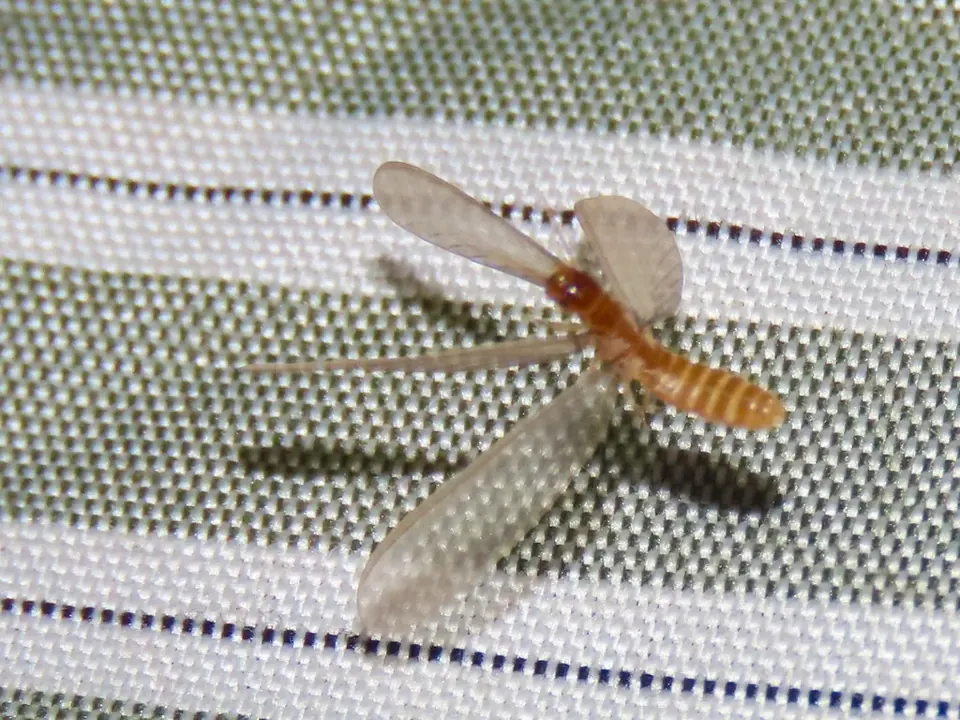
Wings. All four termite wings are the same length and shape 1, extending to about twice the length of the body 14. The front pair of an ant's wings is larger than the rear pair 1.
Wingless insects need one more check. Mated ant queens also shed their wings 15, but only termites keep short wing stubs after the wings break off 16.
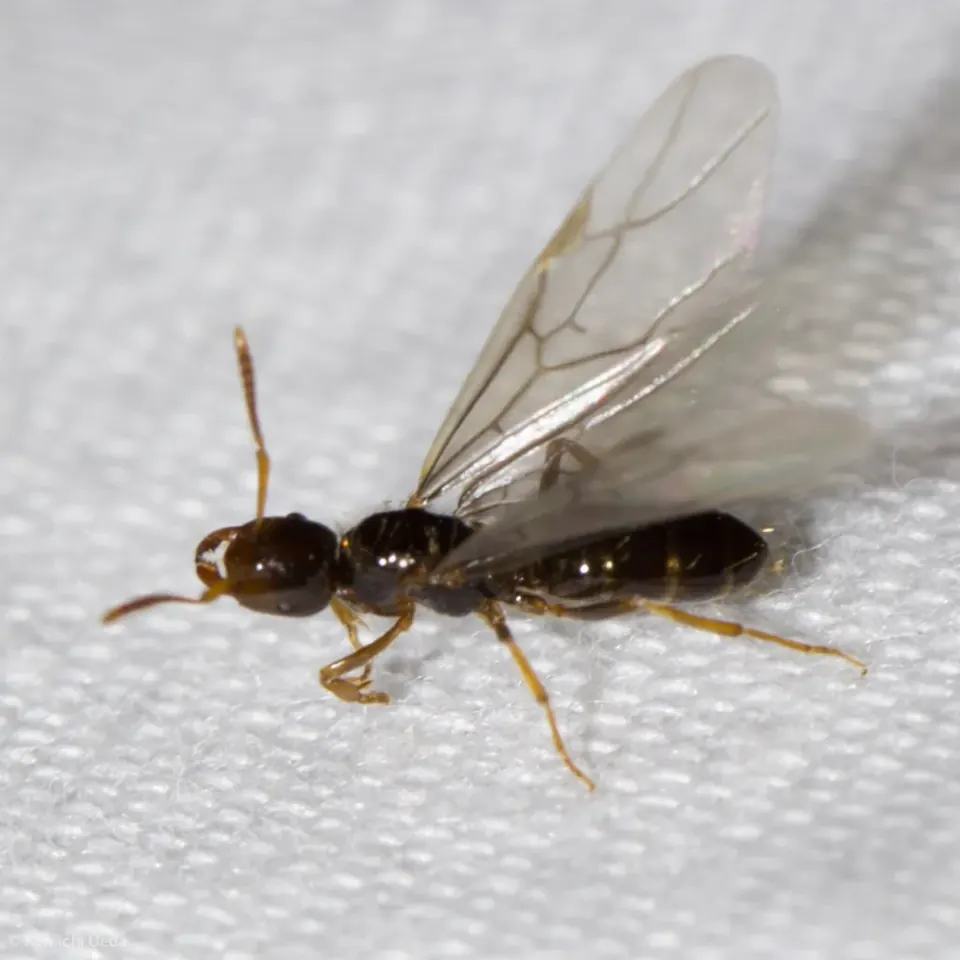
What swarmers look like in each termite group
Body color and size narrow a swarmer to its group, which in turn decides the treatment.
Native subterranean swarmers (Reticulitermes) are about 1/4 to 3/8 inch long, with black to yellow-brown bodies and smoke-gray to brown wings 14. In Mississippi, eastern subterranean swarmers are dark, while Formosan swarmers are tan or golden and larger, easy to tell apart in good light 6.
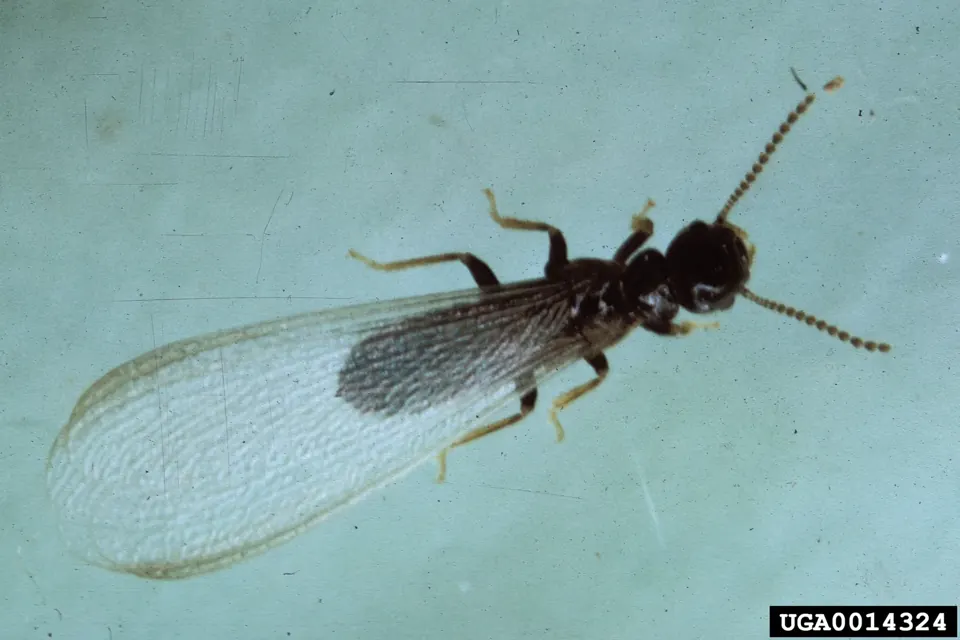
Formosan subterranean termite swarmers are yellowish brown, 12 to 15 mm long with wings, and carry a dense covering of gold to reddish hairs on the wings 17.
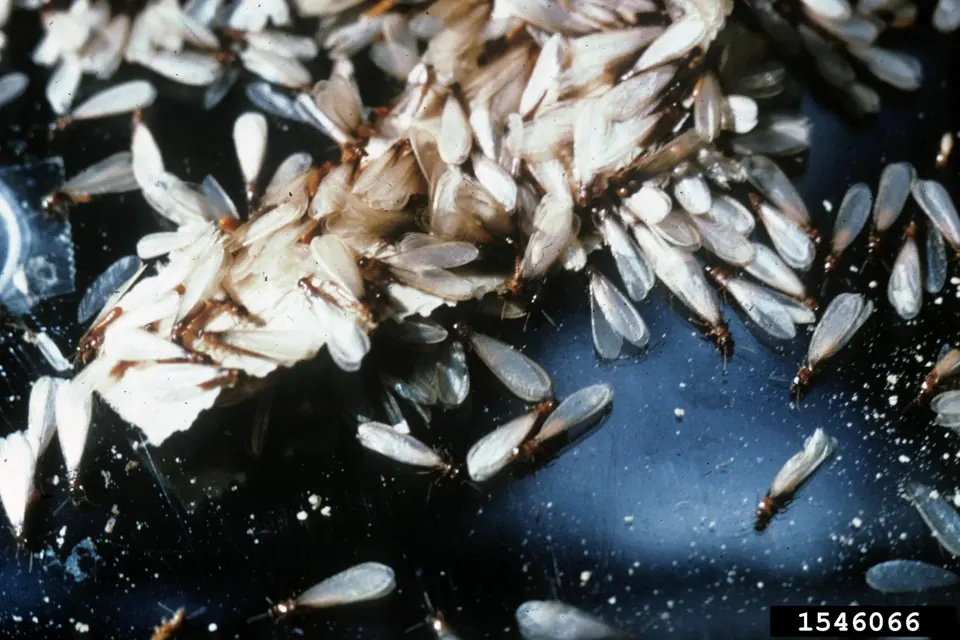
Drywood swarmers vary by species. The western drywood termite (Incisitermes minor) has an orange-brown head and pronotum, a dark brown abdomen and smoky wings, 11 to 12.5 mm long with wings 18. The light southeastern drywood termite (Incisitermes snyderi) is light yellow, about 7/16 inch long, with clear wings 19.
The West Indian drywood termite (Cryptotermes brevis) has a darker body and hairless, vividly iridescent wings 20.
Dampwood swarmers are larger than those of the western drywood termite 21. Pacific dampwood termite swarmers in Oregon measure about 1 inch 22, and Washington State describes them as orange-brown and about 3/4 inch 23. In south Florida, conehead termite swarmers (Nasutitermes corniger) have dark brown bodies, dark wings and a length of 15 to 18 mm 24.
Why termites swarm, and why so few survive
A colony swarms only once it is mature. North Carolina entomologists put that at 3 to 5 years 12, Texas A&M at 2 to 4 years 4. The number of swarmers grows with the age and size of the colony 4.
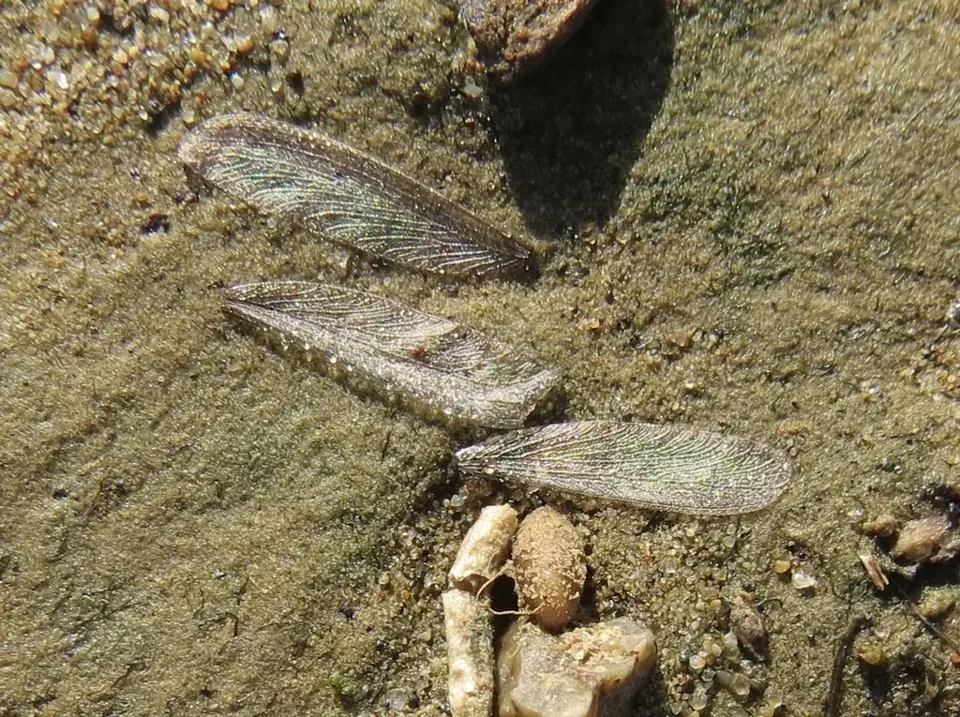
Swarming is how a colony spreads to new sites 1. Male and female swarmers pair off, drop to the ground, shed their wings and run in tandem, female leading, to find a nest site 1. A termite wing breaks off at its base, which is why piles of wings collect where swarmers land 14.
Termites are weak fliers that ride wind currents 4. Native subterranean swarmers in California generally fly less than 100 meters from their colony 2. Formosan swarmers in Louisiana rarely travel more than half a mile 10.
Most swarmers die during the flight, taken by birds, bats, lizards and other insects 11. Heat, light and moisture trigger the emergence, each species with its own requirements 4.
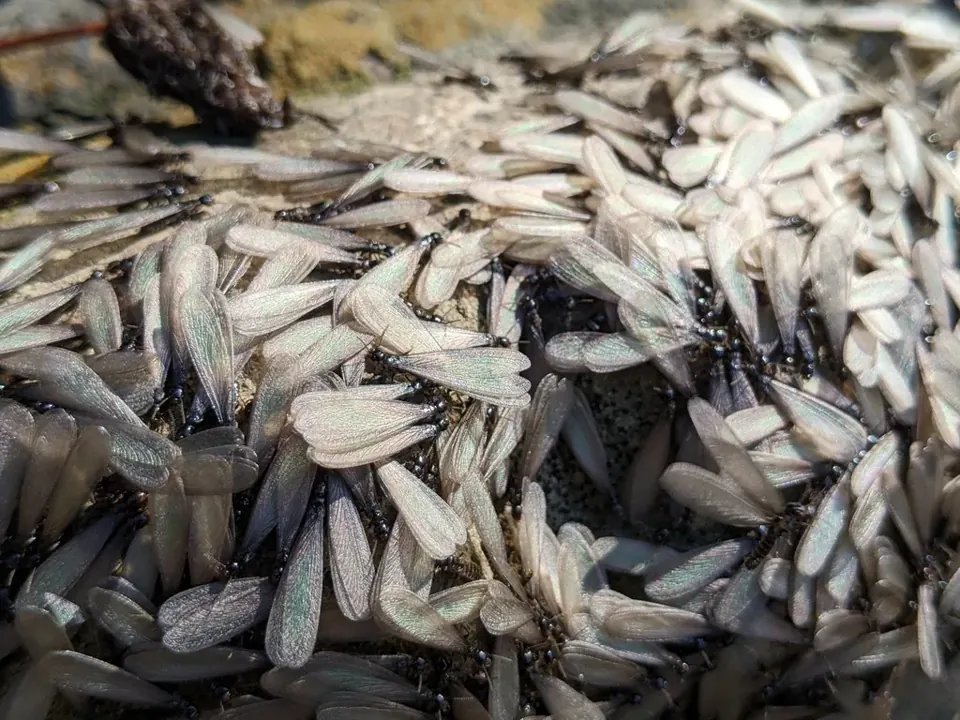
When do termites swarm? Timing by region and species
The time of day and the time of year both vary with the species and its location 2. A date and an hour therefore narrow down which termite produced a swarm.
Native subterranean termites: daytime, mostly spring
Across the United States, flights often occur on the first warm days of spring after rain, earlier in the South than in the North 11. They can happen at any time of year; in buildings with heated basements, termites occasionally fly in winter 11.
- North Carolina: at least three native species swarm from late winter into September or October, usually by day on warm days after rain 12.
- Mississippi: eastern subterranean termites swarm from February to April 6.
- New England: usually March to June, occasionally January on warm days, not in summer or fall 25.
- Texas: swarming begins in January and February in South Texas and not until April and May in the Panhandle 4.
- Florida: Reticulitermes flavipes flies from early January to April in early afternoon, while R. hageni flies in the evening from early December to early February 5.
- California: afternoon flights in spring or fall, on clear days after a soaking rain 2.
- Oregon and Washington: subterranean termites may swarm at any time of year 2223.
- Arizona: the arid land subterranean termite flies in daylight, January to March below 4,000 feet and June to July above it 13. The desert subterranean termite (Heterotermes aureus) flies at dusk after monsoon rain, July to September 13.
Formosan and Asian subterranean termites: dusk, late spring
Formosan termites in Louisiana swarm from April through June, peaking in early to mid May, at dusk on warm, humid, windless evenings 10. Thousands may hover around a single street light 10.
In Florida, Formosan flights run from early April to late June, peak in May and start shortly after sunset 26. Texas flights occur at night from early May through June 17. The Asian subterranean termite (Coptotermes gestroi) flies earlier in south Florida, from February to April, at dusk or night 27.
Drywood termites: daytime in the West, any month in Florida
The western drywood termite flies by day in southern California from late September through November, on bright days of about 80 to 100°F 18. In Arizona the same species peaks from June to August on sunny days, with no link to rain 13.
Florida's records look different: indoor flights of I. minor there have been recorded in every month except December 18. The West Indian drywood termite flies mainly from April to June, but flights are possible at any time of year 20.
Dampwood and conehead termites
Pacific dampwood termites swarm in late summer or fall 22, especially after rain 23. In California, dampwood swarmers are drawn to lights at dark, which separates them from daytime drywood flights 21.
Florida's dampwood termites split by species: Neotermes castaneus peaks in late fall or early winter, while N. jouteli and N. luykxi fly in late spring or summer, at dusk or night 28. Conehead termites swarm in the rainy season, May to November, usually after rain 24.
Indoor swarm or outdoor swarm: what each one means
Swarmers found inside a home usually mean an infestation in or under it 1.
Sources differ on how firm that conclusion is. Mississippi State calls swarmers inside a building a clear indication that it is infested and needs professional treatment 6. NC State is more cautious, noting that swarmers may not always mean an active infestation and leaving the call to a professional inspection 1.
Two situations account for the caution. In heavily infested Formosan neighborhoods, a few dozen swarmers can fly into a properly treated house toward its lights, while hundreds point to a real problem 3. In Louisiana, a few swarmers crawling in a bathroom or kitchen often came in through a vent; swarmers flying indoors or many wings suggest an active infestation 10.
Drywood swarmers inside a structure are almost a sure sign the termites are in its timbers 19. Florida dampwood swarmers indoors are the exception: they usually come from a yard tree or woodland colony 28.
Outdoors, distance from the house matters: swarmers emerging close to the foundation justify a professional inspection 3. Swarmers rising from a stump or woodpile 25 feet or more away are rarely a concern 3. Oregon State goes further for its largest species, calling flying Pacific dampwood termites no cause for alarm 22.
A colony in the yard still matters over time, because its future swarmers may attack a house that has no protection 1.
What the swarm means for treatment
Treatment depends on the termite group, which is why the specimen in alcohol matters.
Subterranean termites are controlled with a liquid termiticide in the soil or with a bait system, chosen after a thorough inspection 17. When tubes on ceilings or upper floors show a colony living above ground on a leak, NC State makes correcting the moisture problem the first step 12.
Drywood termites need either a whole-structure treatment, such as fumigation or heat, or a localized treatment of the infested boards 21. Soil termiticides and baits do not apply to them 7. Dampwood termites are usually controlled by drying the infested wood 7.
A specimen sent to an extension lab settles the group. Several labs offer free termite identification, including the UF/IFAS lab in Fort Lauderdale 29. A termite inspection then shows how far the colony reaches. With the group and the extent known, the treatment options narrow to the ones that fit.
Questions
Should I spray flying termites?
Spraying kills the swarmers you can see but gives no protection against the colony that produced them 1. Collecting a few for identification and arranging an inspection does more good 1.
Do flying termites eat wood?
No. Swarmers do not cause structural damage; the worker termites in the colony do the feeding 1.
Why are flying termites around my lights?
Several species fly toward light, including Formosan termites at dusk, light southeastern drywood termites at night and dampwood termites after dark 101921. Swarmers trapped indoors also gather and die at windows 5.
Does one flying termite mean my house is infested?
Not necessarily. In Louisiana a few swarmers often get in through vents, while swarmers flying indoors or large numbers of shed wings point to an active infestation 10.
Sources
- Crawley, S., and C. C. Hayes. Termite Swarmers: What Do They Mean for You? NC State Extension Publications. Published Dec. 1, 2009; reviewed/revised Feb. 24, 2023. content.ces.ncsu.edu
- Lewis, V. R., M. I. Haverty, and A. M. Sutherland. Pest Notes: Subterranean and Other Termites. UC ANR Publication 7415. UC Statewide IPM Program. Updated 05/2014. ipm.ucanr.edu
- Mississippi State University Extension Service, Dept. of Entomology. Signs of Termite Infestation. Year not stated. extension.msstate.edu
- Texas A&M University, Urban and Structural Entomology Program. Native Subterranean Termites, Reticulitermes sp. (web page). Year not stated. urbanentomology.tamu.edu
- Chouvenc, T., N.-Y. Su, and R. H. Scheffrahn. Native Subterranean Termites: Reticulitermes flavipes, R. virginicus, R. hageni. UF/IFAS EDIS EENY-212 (IN369). Original May 2004; revised July 2024. doi:10.32473/edis-in369-2001. ask.ifas.ufl.edu
- Layton, B. Eastern Subterranean Termite Swarmers. Bug's Eye View, Vol. 8, No. 2 (2022). Mississippi State University Extension Service. extension.msstate.edu
- Oi, F. M., J. Davis, J. McConnell, J. Corbus, N. Nelson, and M. Atkinson. Termite Prevention and Control. UF/IFAS Extension ENY-2044 (IN1277). Original March 2020; revised December 2023. ask.ifas.ufl.edu
- Basnagala, S., T.-Y. Lee, and K. I. Perry. Eastern Subterranean Termite, Reticulitermes flavipes. Buckeye Yard and Garden onLine (BYGL), Ohio State University. Published May 13, 2024. bygl.osu.edu
- LSU AgCenter, LSU Department of Entomology, and Louisiana State Arthropod Museum. Insect Identification Services. LSU AgCenter Publication 1838. Year not stated. www.lsuagcenter.com
- Sun, Q. Preparing for the Termite Swarms. LSU AgCenter. Published April 20, 2026. www.lsuagcenter.com
- Peterson, C., T. L. Wagner, J. E. Mulrooney, and T. G. Shelton. Subterranean Termites: Their Prevention and Control in Buildings. USDA Forest Service, Home and Garden Bulletin 64. Revised October 2006. research.fs.usda.gov
- Hayes, C. Monitoring and Management of Eastern Subterranean Termites. NC State Extension Publications. Publication date Jan. 22, 2025. content.ces.ncsu.edu
- Baker, P. B., and R. J. Marchosky, Jr. Arizona Termites of Economic Importance. University of Arizona Cooperative Extension AZ1369. June 2005. extension.arizona.edu
- Gibb, T. J. Finding Winged Termites Is a Red Flag. Purdue Extension Hot News HN-61-W. Dated 5/15/2009. extension.entm.purdue.edu
- Collins, L., and R. H. Scheffrahn. Red Imported Fire Ant, Solenopsis invicta. UF/IFAS EDIS EENY-195 (IN352). Original January 2001; revised November 2013; reviewed May 2020. ask.ifas.ufl.edu
- University of Hawaii at Manoa, CTAHR, Dept. of Plant and Environmental Protection Sciences. UH Termite Project, Alate Project: Identification Guide. Year not stated. manoa.hawaii.edu
- Gold, R. E., M. Keck, E. Brown, and K. Schofield. Formosan Subterranean Termites. Texas AgriLife Extension Service, E-367 (dated 9/10). extensionentomology.tamu.edu
- Cabrera, B. J., and R. H. Scheffrahn. Western Drywood Termite, Incisitermes minor. UF/IFAS EDIS EENY248 (IN526). Original November 2001; revised December 2005; reviewed February 2021. ask.ifas.ufl.edu
- Texas A&M University, Urban and Structural Entomology Program. Drywood Termites (web page). Year not stated. urbanentomology.tamu.edu
- Gordon, J. M., R. H. Scheffrahn, and N.-Y. Su. West Indian Drywood Termite, Cryptotermes brevis. UF/IFAS EDIS EENY-79 (IN236). Original April 1999; revised December 2025. doi:10.32473/EDIS-in236-2020. ask.ifas.ufl.edu
- Lewis, V. R., A. M. Sutherland, and M. I. Haverty. Pest Notes: Drywood Termites. UC ANR Publication 7440. UC Statewide IPM Program. Updated 08/2014. ipm.ucanr.edu
- Oregon State University Extension. Solve Pest Problems: Termites. Year not stated. solvepestproblems.oregonstate.edu
- Washington State University, Pestsense. Termites (fact sheet). Year not stated. pestsense.cahnrs.wsu.edu
- Tong, R. L., K. E. Tenn, and R. H. Scheffrahn. Conehead Termite, Nasutitermes corniger. UF/IFAS EDIS EENY-745 (IN1275). Original December 2019. ask.ifas.ufl.edu
- Dugas, K. Eastern Subterranean Termite (Reticulitermes flavipes). Connecticut Agricultural Experiment Station fact sheet. Year not stated. portal.ct.gov
- Su, N.-Y., R. H. Scheffrahn, J. Gordon, and T. Chouvenc. Formosan Subterranean Termite, Coptotermes formosanus. UF/IFAS EDIS EENY121 (IN278). Original January 2000; revised September 2025. ask.ifas.ufl.edu
- Scheffrahn, R. H., and N.-Y. Su. Asian Subterranean Termite, Coptotermes gestroi (=havilandi). UF/IFAS EDIS EENY128 (IN285). Original April 2000; revised April 2005; reviewed February 2021. ask.ifas.ufl.edu
- Scheffrahn, R. H., and N.-Y. Su. Florida Dampwood Termites, Neotermes castaneus, N. jouteli, and N. luykxi. UF/IFAS EDIS EENY122 (IN279). Original January 2000; revised December 2005; reviewed February 2021. ask.ifas.ufl.edu
- UF/IFAS Fort Lauderdale Research and Education Center. Send Samples (Termites in Florida). Last modified June 15, 2026. flrec.ifas.ufl.edu