What do termites look like?
Each caste with measurements from university extension and UF/IFAS descriptions, shown in licensed photos of real specimens.
Termite workers, the caste found in infested wood, are pale, soft-bodied insects roughly 1/8 to 1/4 inch long, with straight, bead-like antennae and no pinched waist 12. Soldiers look similar but carry a large brownish head with strong jaws 3. Swarmers are darker, about 1/4 to 3/8 inch long, with four equal wings that extend past the body 4.
Termites rarely show themselves, which makes every sighting worth a close look. Subterranean termites are almost never seen foraging in the open 5. They stay underground, inside wood or in mud tubes to keep the humidity they need 4.
When termites do appear, they arrive as one of several castes. Perhaps you split a damp board and found pale insects scattering, or swept dark winged insects off a windowsill.
But a worker, a soldier and a swarmer from the same colony look like three different insects, each with lookalikes of its own.
So which of the insects in front of you is a termite, and which caste is it? We matched each caste to its measurements in extension and UF/IFAS publications and to licensed photos of real specimens.
Features every termite shares, whatever its job
All termites have moniliform antennae, meaning straight and built from bead-like segments 6. In ants the antennae bend sharply like an elbow 7.
The body is the second giveaway. A termite's body extends straight back from the head without the pinched, wasp-like waist of an ant 7. Termites are also soft-bodied and light in color, while ants are generally hard-bodied and dark 8.
That pale, soft look has earned termites the name "white ants" 1. The name misleads: termites are more closely related to cockroaches than to ants 9. UF/IFAS places them in the cockroach order, Blattodea 10.
Workers: small, pale and the ones eating the wood
Workers, wingless and white to creamy white, make up the largest part of a colony and do all of its work 3. Their mouthparts are hard and adapted for chewing through wood, so the worker caste causes the damage 3.
Size depends on the species and on who measured it. UF/IFAS describes workers as about 1/8 inch long 1, and gives Formosan workers as about 3 to 4 mm 6. Washington State University puts subterranean workers at about 1/4 inch 2, and Texas A&M gives a larger 1/4 to 3/8 inch for native workers 3.
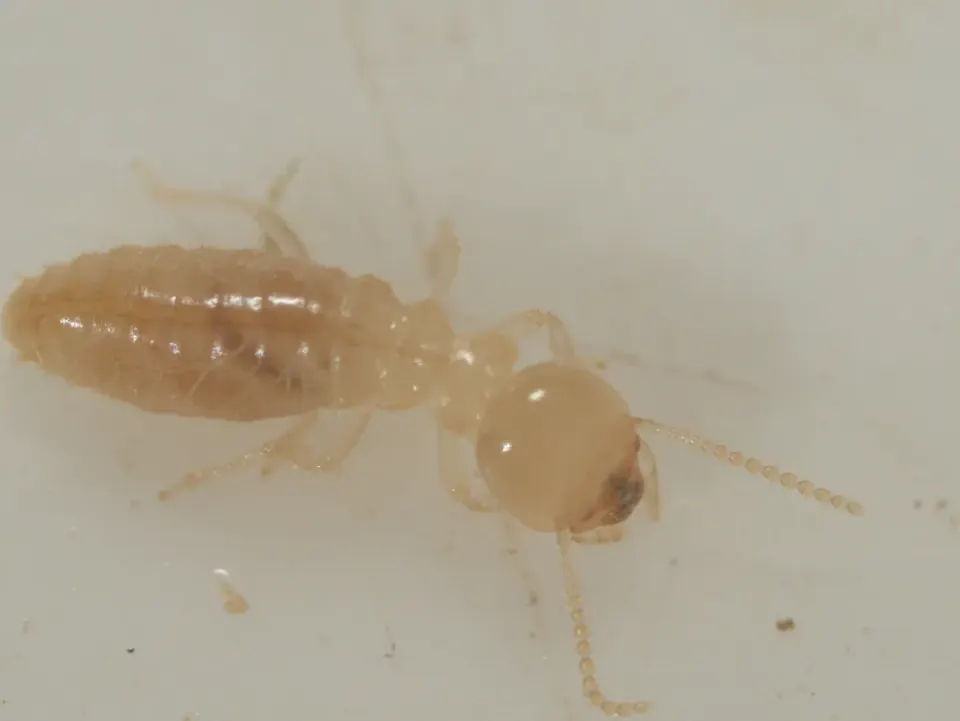
Termite workers are blind 11. They avoid exposure to open air, which is why they are seen mostly when wood is opened or a tube is broken 5.
Drywood and dampwood termites have no true worker caste. In drywood termites, the same jobs fall to "pseudergates", or false workers, which can still molt into soldiers or winged reproductives 12. In dampwood termites, immature soldiers and reproductives do the work of the colony 13. Dampwood workers are larger than subterranean ones, about 1/2 inch in Washington 2.
Soldiers: termites with heads built for defense
Soldiers resemble workers in color and body shape. The difference is the head: well developed, brownish, with strong mandibles 3. Soldiers defend the colony, mainly against ants and other termites, and depend on workers to feed them 3.
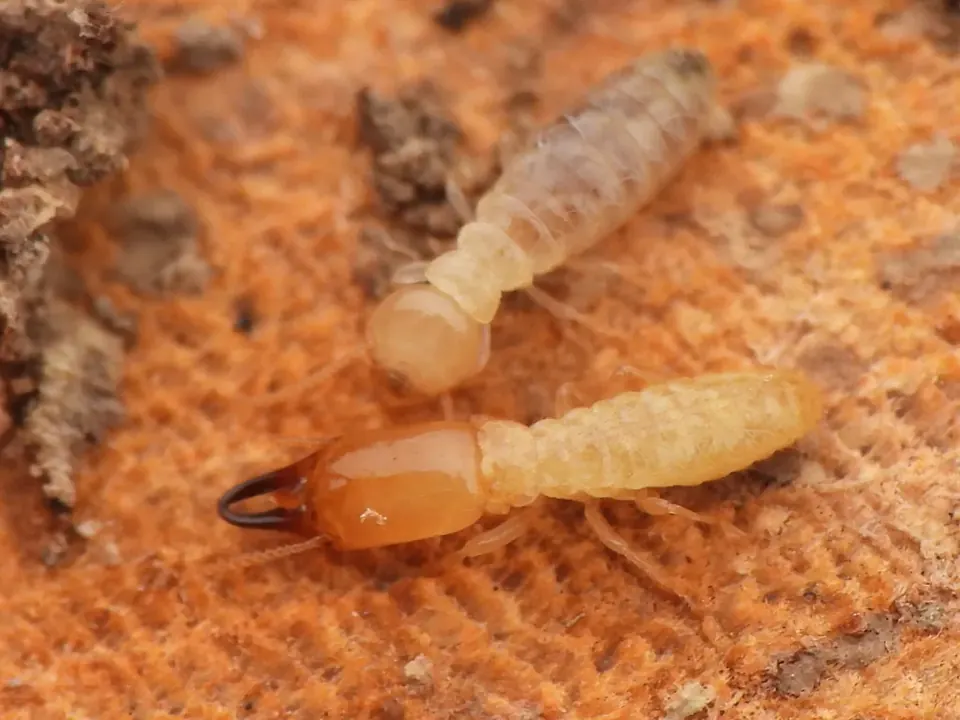
The head also tells you the group. Native subterranean soldiers (Reticulitermes) have a rectangular head 10. Formosan soldiers (Coptotermes formosanus) have a white body and a brownish-orange, teardrop-shaped head, and measure about 4 to 5 mm 6. When disturbed, a Formosan soldier oozes a white, glue-like droplet from the front of its head 6.
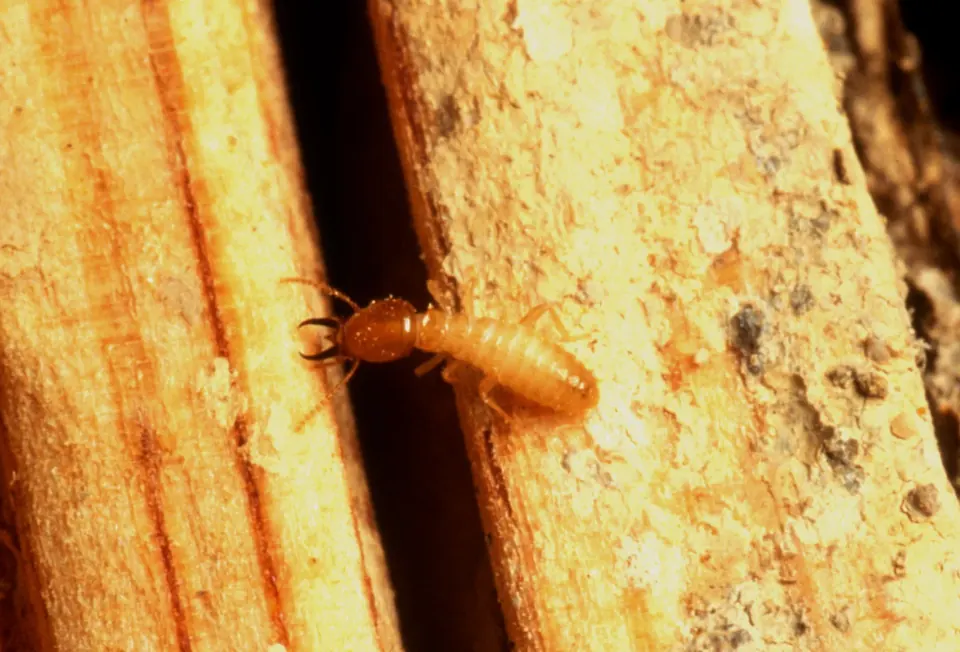
Drywood soldiers are bigger and darker. In the western drywood termite, soldiers of mature colonies reach 8 to more than 12 mm, with a large, reddish-brown head 12. The West Indian drywood termite has a dark, roughened, plug-shaped head 1412, the kind UF/IFAS says is sometimes likened to a burnt matchstick 1.
At the far end of the size range, Pacific dampwood soldiers grow to 15 to 20 mm, with a dark brown head and black mandibles 13. Conehead termite soldiers are only about 5 mm long and have no large jaws at all 15. Instead, their brown to black head ends in a cone, the nasus, that secretes a defensive fluid 15.
Swarmers: the termites people actually notice
Swarmers, or alates, are the winged reproductives. They leave the colony in large numbers all at once, usually in spring and after rain 4.
Purdue Extension notes that as a native subterranean nymph matures into a swarmer, its body turns black and its eyes become functional 4. Its wings grow to about twice its body length 4. Native subterranean swarmers are about 1/4 to 3/8 inch long, black to yellow-brown, with four equal smoke-gray to brown wings 4.
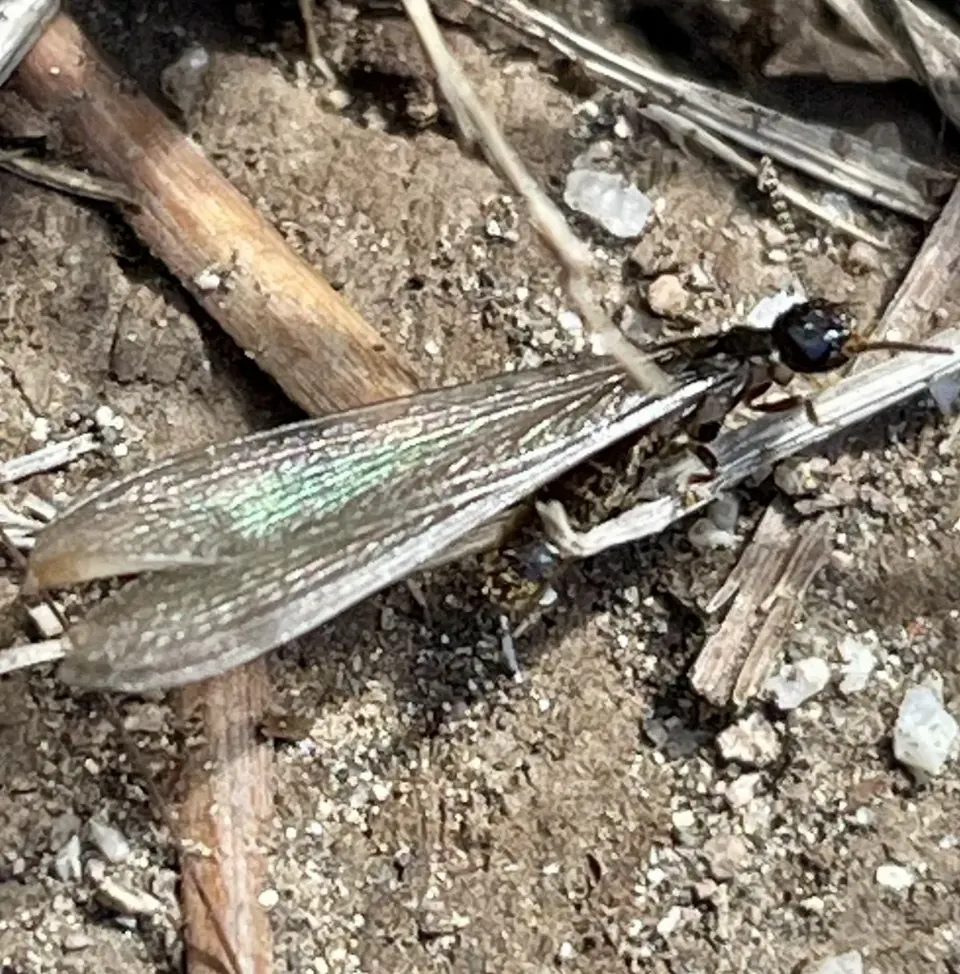
Within that pattern, eastern subterranean termite alates are dark brown, almost black to the naked eye, and about 0.4 inch long including wings 10. The light southern subterranean termite is smaller, about 0.3 inch, and yellowish brown 10.
Formosan alates are larger, about 12 to 15 mm, orange or light amber-brown, with small hairs on the wings and body 6. Western drywood alates have an orange-brown head and pronotum, a dark brown abdomen and smoky wings, and measure 11 to 12.5 mm with wings 12. Washington's dampwood swarmers are orange-brown and about 3/4 inch long 2.
Swarmers keep their wings for only a short time. The wings break at the base and are discarded, sometimes in large piles 4. A termite that has dropped its wings (a dealate) keeps short wing stubs, which ants do not have 16.
Where each caste turns up in a house
Swarmers are the caste found in plain view. Texas A&M lists swarmers on windowsills or near indoor lights as the first sign most homeowners notice 3. Their shed wings collect on sills and in cobwebs indoors 3.
After indoor flights, native subterranean alates are usually found dead and dried near windows, or in sinks and bathtubs, often with their wings still attached 10. Formosan swarmers gather around lights at night 17.
Workers and soldiers stay out of sight until something exposes them. When one Formosan shelter tube was broken, soldiers and workers were readily seen inside 17. A BB-sized spot of dried mud on a wall can hide a pinhole, where a termite may come to investigate after the mud is scraped away 17.
In late spring, Formosan termites sometimes build odd lumps of dried mud on walls or ceilings, called swarm castles, before they swarm 17. Breaking into one usually brings soldiers to the breach 17.
Kings, queens and the termites that replace them
Each swarming pair that survives becomes the king and queen of a new colony. With age, the queen's abdomen can become greatly expanded with developing eggs, reaching several times the size of a worker 5.
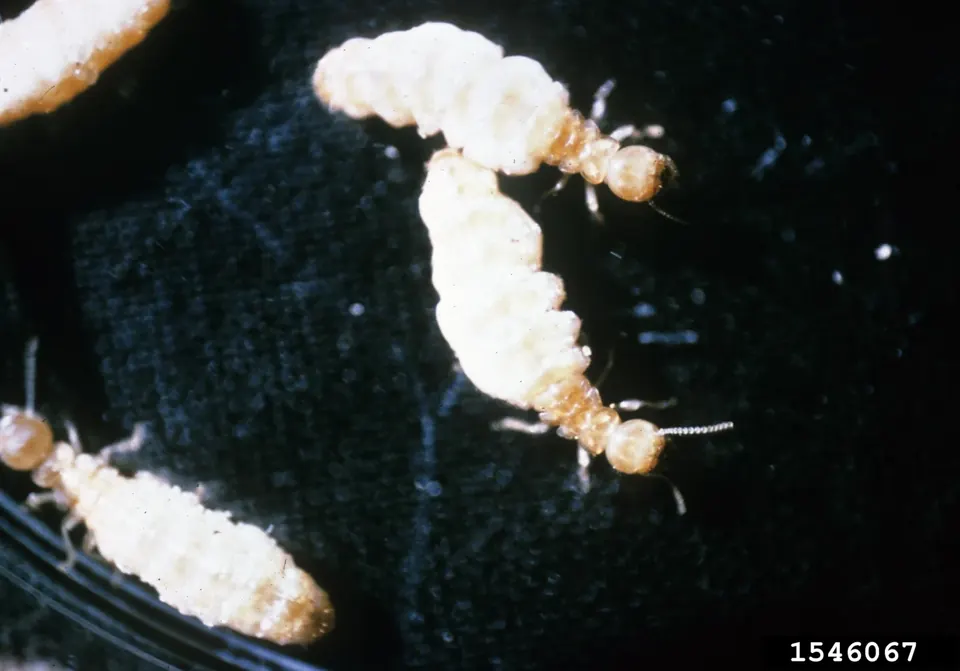
Many colonies also hold backup reproductives. In native subterranean termites, these secondary and tertiary reproductives are white to cream-colored and live inside the colony 3. They mate there and can replace the primary queen if she is injured or dies 3.
The USDA Forest Service notes that intermediate forms like these are rarely observed by homeowners, or even by pest management professionals 5.
Baby termites: eggs, larvae and nymphs
Termites develop by simple metamorphosis 12. In native subterranean termites, an egg hatches into a larva, which develops into a worker 3. Workers can later molt into a soldier or into a nymph with wing pads, which eventually becomes a swarmer 3.
In Formosan termites, larvae pass through two stages before molting into a soldier or a worker 6. Nymphs are produced seasonally in mature colonies to become the next generation of alates 10.
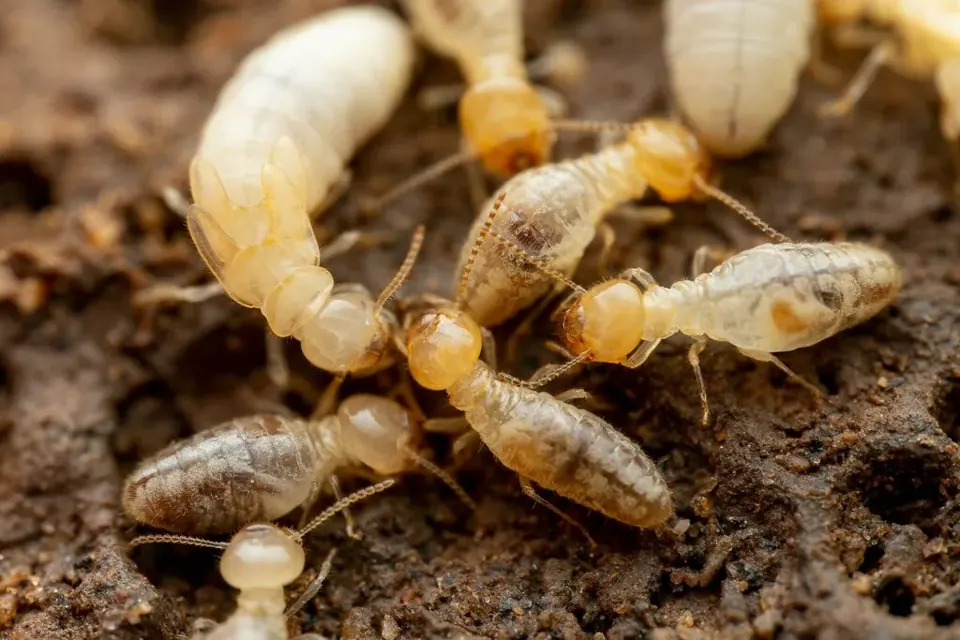
A nymph is the easiest young termite to recognize. It looks like a worker carrying wing pads, the short beginnings of wings, on its thorax 3.
Tiny pale insects are not always young termites. Booklice are only 1 to 2 mm long, wingless and pale, and resemble miniature termites 18. Their long, threadlike antennae, prominent head and constriction behind the head set them apart 18. Powderpost beetle larvae, found inside infested wood, are creamy white, C-shaped grubs 19. Both belong to the list of bugs that look like termites, each with its own deciding check.
Comparing your own termite with these pictures
A fair comparison needs scale. LSU AgCenter asks for identification photos that are in focus and include a coin, pen or ruler, with the date and location noted 20.
Pictures can separate a worker from a soldier, and a termite from an ant, using the characters in the termite identification key. Naming the species is harder: UF/IFAS states that it usually requires a microscope or a high-resolution camera, even for an experienced identifier 21.
For a definite answer, soldiers and swarmers are the castes to keep, since workers cannot be identified to species 22. A small, tightly sealed container of rubbing alcohol keeps them intact for a lab 1. Several university labs offer free termite identification for specimens sent this way 2223.
Questions
What color are termites?
Workers are white to cream. Soldiers have the same pale body with a brownish or orange head 36. Swarmers are darker, from black to yellow-brown depending on the species 4.
How big is a termite?
Workers of common US subterranean termites are roughly 1/8 to 1/4 inch long 12. Swarmers of the same termites measure about 1/4 to 3/8 inch with wings 4, while Pacific dampwood swarmers reach about 1 inch 24.
What do baby termites look like?
Young termites look like small, pale workers. Older nymphs grow wing pads on the thorax before they molt into winged swarmers 3.
What does a termite queen look like?
An older queen has a greatly swollen abdomen full of developing eggs and can reach several times the size of a worker 5.
Sources
- Oi, F. M., J. Davis, J. McConnell, J. Corbus, N. Nelson, and M. Atkinson. Termite Prevention and Control. UF/IFAS Extension ENY-2044 (IN1277). Original March 2020; revised December 2023. ask.ifas.ufl.edu
- Washington State University, Pestsense. Termites (fact sheet). Year not stated. pestsense.cahnrs.wsu.edu
- Texas A&M University, Urban and Structural Entomology Program. Native Subterranean Termites, Reticulitermes sp. (web page). Year not stated. urbanentomology.tamu.edu
- Gibb, T. J. Finding Winged Termites Is a Red Flag. Purdue Extension Hot News HN-61-W. Dated 5/15/2009. extension.entm.purdue.edu
- Peterson, C., T. L. Wagner, J. E. Mulrooney, and T. G. Shelton. Subterranean Termites: Their Prevention and Control in Buildings. USDA Forest Service, Home and Garden Bulletin 64. Revised October 2006. research.fs.usda.gov
- Su, N.-Y., R. H. Scheffrahn, J. Gordon, and T. Chouvenc. Formosan Subterranean Termite, Coptotermes formosanus. UF/IFAS EDIS EENY121 (IN278). Original January 2000; revised September 2025. ask.ifas.ufl.edu
- University of Maryland Extension, Home and Garden Information Center. Ants and Termites: How to Tell the Difference. Updated October 17, 2024. extension.umd.edu
- Morgan, A., D. Ring, L. Mao, et al. The Identification of Formosan Subterranean Termites. LSU AgCenter Pub. 2841 (dated 3/06). Additional authors not fully extracted. www.lsuagcenter.com
- Baker, P. B., and R. J. Marchosky, Jr. Arizona Termites of Economic Importance. University of Arizona Cooperative Extension AZ1369. June 2005. extension.arizona.edu
- Chouvenc, T., N.-Y. Su, and R. H. Scheffrahn. Native Subterranean Termites: Reticulitermes flavipes, R. virginicus, R. hageni. UF/IFAS EDIS EENY-212 (IN369). Original May 2004; revised July 2024. doi:10.32473/edis-in369-2001. ask.ifas.ufl.edu
- Dugas, K. Eastern Subterranean Termite (Reticulitermes flavipes). Connecticut Agricultural Experiment Station fact sheet. Year not stated. portal.ct.gov
- Cabrera, B. J., and R. H. Scheffrahn. Western Drywood Termite, Incisitermes minor. UF/IFAS EDIS EENY248 (IN526). Original November 2001; revised December 2005; reviewed February 2021. ask.ifas.ufl.edu
- Cannings, R. A., and G. G. E. Scudder. Families of Isoptera of British Columbia. In: Klinkenberg, B. (ed.) 2023. E-Fauna BC: Electronic Atlas of the Fauna of British Columbia. Dept. of Geography, University of British Columbia. linnet.geog.ubc.ca
- Gordon, J. M., R. H. Scheffrahn, and N.-Y. Su. West Indian Drywood Termite, Cryptotermes brevis. UF/IFAS EDIS EENY-79 (IN236). Original April 1999; revised December 2025. doi:10.32473/EDIS-in236-2020. ask.ifas.ufl.edu
- Tong, R. L., K. E. Tenn, and R. H. Scheffrahn. Conehead Termite, Nasutitermes corniger. UF/IFAS EDIS EENY-745 (IN1275). Original December 2019. ask.ifas.ufl.edu
- University of Hawaii at Manoa, CTAHR, Dept. of Plant and Environmental Protection Sciences. UH Termite Project, Alate Project: Identification Guide. Year not stated. manoa.hawaii.edu
- Mississippi State University Extension Service, Dept. of Entomology. Signs of Termite Infestation. Year not stated. extension.msstate.edu
- Colorado State University. Colorado Insects of Interest: Booklice (fact sheet). Year not stated. webdoc.agsci.colostate.edu
- Merchant, M. Lyctid Powderpost Beetles: Suggestions for Control. Texas A&M AgriLife Extension, Insects in the City fact sheet ENT-2008. Year not stated. citybugs.tamu.edu
- LSU AgCenter, LSU Department of Entomology, and Louisiana State Arthropod Museum. Insect Identification Services. LSU AgCenter Publication 1838. Year not stated. www.lsuagcenter.com
- Chouvenc, T., R. H. Scheffrahn, and L. Buss. Termite Species Distribution in Florida and UF Termite Identification Services. UF/IFAS EDIS ENY-2079 (IN1360). Original May 2022; reviewed February 2025. doi:10.32473/edis-IN1360-2022. ask.ifas.ufl.edu
- Mississippi State University Extension Service. Insect Identification Service (termites). Year not stated. extension.msstate.edu
- UF/IFAS Fort Lauderdale Research and Education Center. Send Samples (Termites in Florida). Last modified June 15, 2026. flrec.ifas.ufl.edu
- Oregon State University Extension. Solve Pest Problems: Termites. Year not stated. solvepestproblems.oregonstate.edu