Termite mud tubes
Tube types, the one-inch activity test used by extension entomologists, and the treatment that follows an active tube.
Termite mud tubes are pencil-width tunnels of soil, wood bits and saliva that subterranean termites build to cross open surfaces between soil and wood 12. To test one, break about an inch and look for termites, or check after a few days whether it has been rebuilt 31. An empty tube does not prove the termites are gone 4.
Shelter tubes, often called mud tubes, are the most commonly seen evidence of subterranean termites 2. That group causes the vast majority of termite losses in the United States 1, so a tube on the foundation deserves attention.
For the termites, the tubes are a way to travel without drying out. In exposed areas they must protect themselves from the drying effects of air 1, so they build tubes that shield them and hold in humidity 4.
Maybe you spotted a brown, crusty line running up a pier while storing boxes in the crawlspace.
But a tube does not say whether termites still use it. Should you break it, leave it for an inspector or scrape it off? And if it turns out to be empty, are the termites gone?
We followed the tube checks published by Mississippi State, NC State, the USDA Forest Service and UC IPM.
What termite mud tubes look like
The tubes are usually about 1/4 to 1/2 inch wide 1, which a Connecticut fact sheet describes as pencil-sized 5. Workers build them from soil and bits of wood, or even drywall, held together with saliva 2. Ohio State adds feces and cellulose to the mix 6.
Construction varies. Some tubes are thin and fragile, while others have thick walls wide enough for many termites to move up and down at once 7. Tubes can also blend into the soil or concrete beside them, which makes them hard to see 7.
Material is a clue to the colony's location. Tubes built by a colony living above ground usually contain wood, drywall or whatever the termites are eating, rather than soil 4.
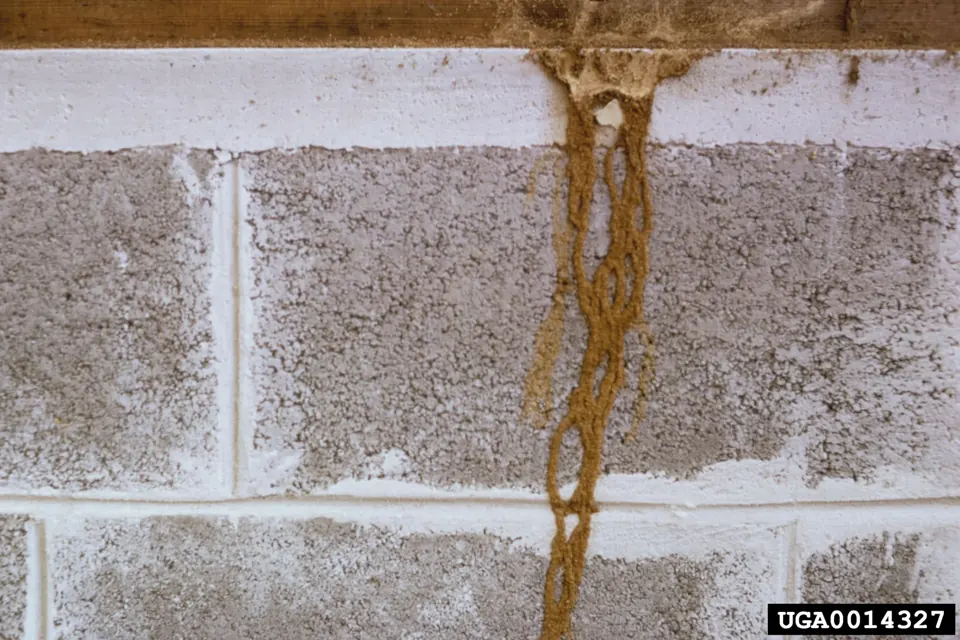
Four kinds of tube, four different messages
UC IPM sorts shelter tubes into four types 2. Telling them apart helps read what the colony is doing.
Working tubes run from the nest in the soil to wooden parts of a structure, often straight up a concrete or stone foundation 2. A working tube shows that termites have reached wood in the building.
Exploratory and migratory tubes rise from the soil but do not connect to any wooden structure 2. They mark termites foraging from the soil that have not yet connected to wood at that spot.
Drop tubes hang from wooden structures back down to the soil 2. Because they start in the wood, they point to termites already established in the timber above.
Swarm tubes are built for winged kings and queens to emerge from during swarm season 2.
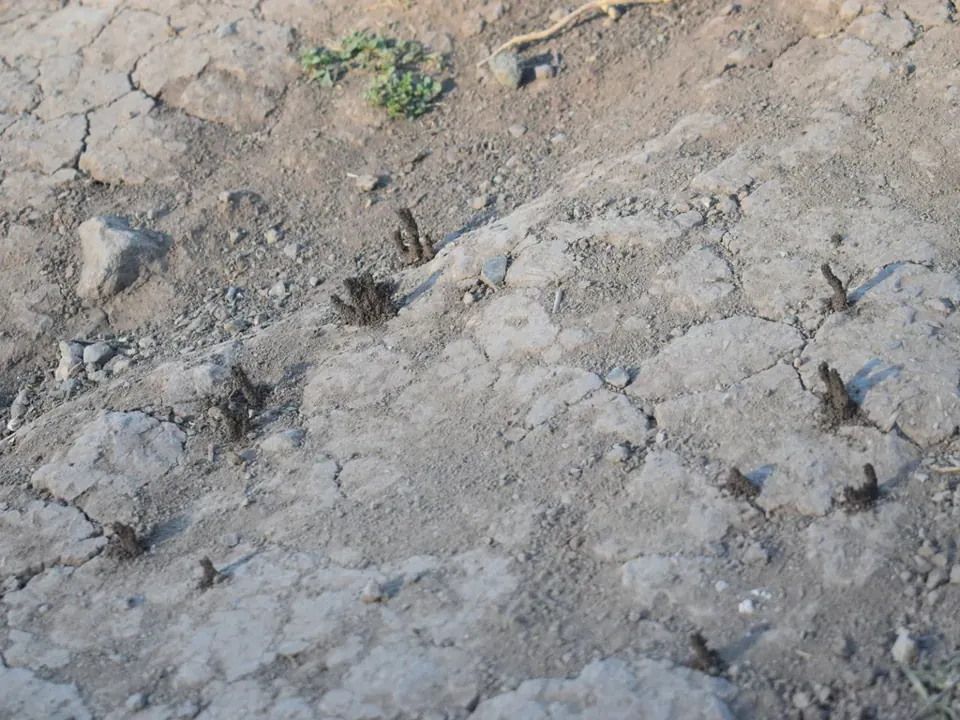
Where tubes turn up, inside and outside
NC State lists foundation walls, floor joists, the underside of subfloors and the cracks between structural members as common places 4. Tubes can also run inside drywall and insulation 4. Mississippi State adds support piers and plumbing under the house 3.
Outside, tubes often climb the edge of a slab to enter beneath the lowest course of siding 3. Texas A&M recommends checking along cracks, in corners and wherever the top of the foundation sits close to the ground 7. Termites can pass through cracks as narrow as 0.03 inch (0.8 mm) 1.
Some tubes stay hidden. Stucco that runs down to the soil lets termites travel unseen between the stucco and the foundation 2. Spray foam insulation also obscures inspections; UF/IFAS notes that many pest control companies will not warranty homes that have it 8.
Height changes the diagnosis. Tubes high on interior walls, ceilings, soffits or fascia usually indicate Formosan termites 3. Tubes along ceilings or upper floors can also mean an above-ground colony that lives in the building on a leak or other moisture source 4.
UF/IFAS recommends keeping at least 6 inches between the bottom of the siding and the soil or mulch line, precisely so tubes stay visible 8.
How to test whether a mud tube is active
Whether termites still use a tube can only be seen by opening it 31. The test takes a few minutes plus a follow-up visit.
- Photograph the tube first. Include a coin or ruler for scale and record the date and location 9. The photo keeps a record for the inspector and for the VTI test.
- Break a short section. Mississippi State recommends carefully breaking a 1-inch section 3. A screwdriver works well for opening suspect tubes 7.
- Look into the break right away. Live workers and soldiers may run through an active tube when it is opened 2. When Mississippi State broke one Formosan tube, soldiers and workers were readily seen 3.
- Mark the spot and come back. If no termites appear, check back over the next few days for a repair or a new tube 31.
- Read the result. Termites in the break, or a repaired tube, mean the building has an active infestation 3.
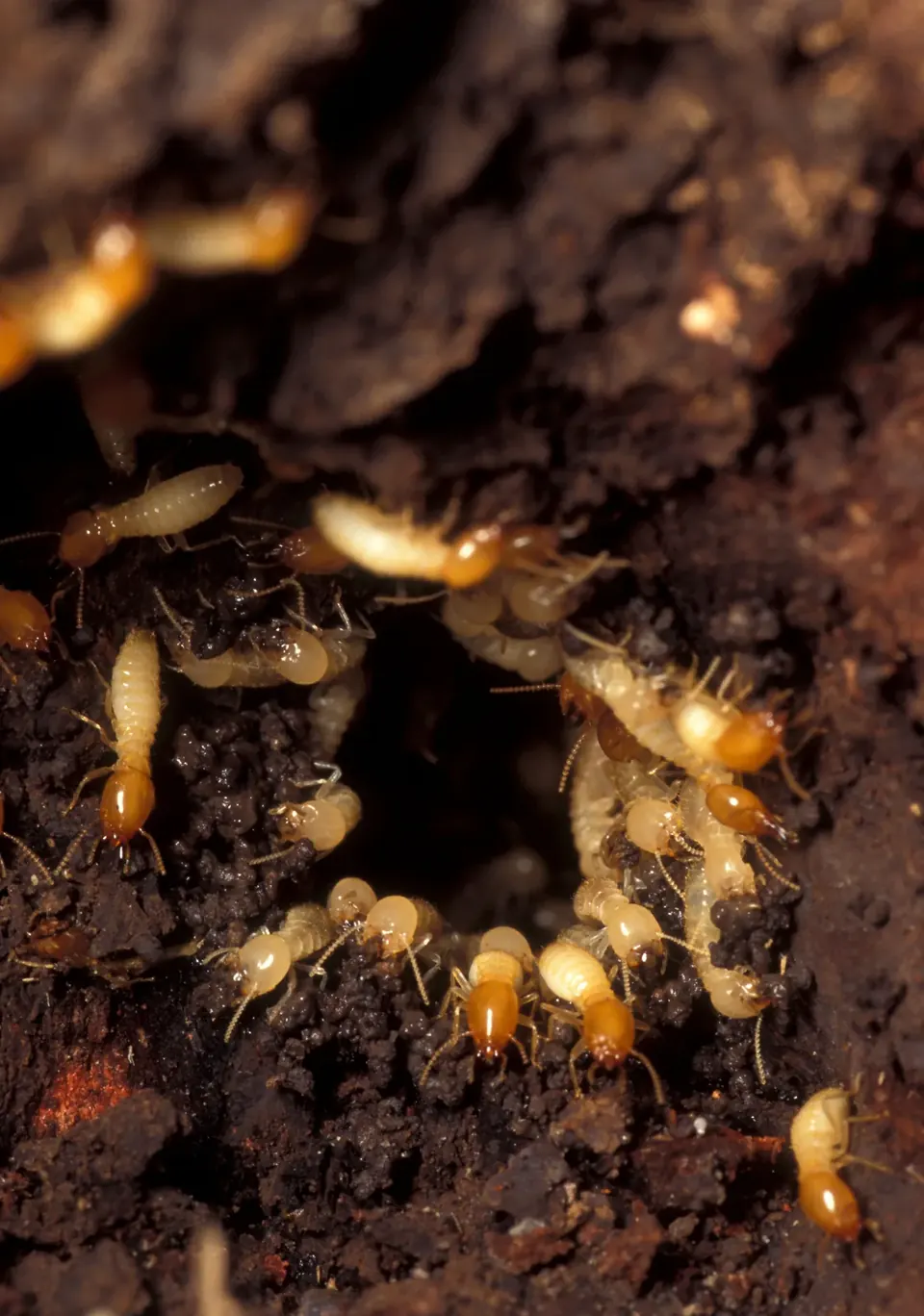
An empty, unrepaired tube is not an all-clear. Termites regularly abandon tunnels and rebuild those that become damaged 4. The tube you can see may not be the only route termites use to enter the building 3.
Old tubes look different: they dry out and crumble easily, often leaving an etched trace on the surface that stays visible for years 4. Without the inspection history of the house, NC State notes, the age of a tube or etching cannot be judged 4.
Break it, leave it or scrape it off?
Mississippi State, the USDA Forest Service and NC State all tell homeowners to break a section to test activity 314.
Breaking or removing tubes does not control the colony. The termites remain in the ground and will find other ways into the building 3. UC IPM still advises destroying tubes between soil and wood once an infestation is found, as part of the control effort 2.
The order follows from those two points. Photograph, test and arrange an inspection first, because Mississippi State advises a professional inspection whenever mud tubes are found, even with no live termites 3. Once an infestation has been controlled, old tubes should be scraped away so they do not confuse later inspections 3.
Tubes that are not on a house: desert and tree termites
In Arizona, some earthen structures in the yard belong to a termite that rarely threatens buildings. The tube-building desert termite (Gnathamitermes perplexus) covers palms and wooden fences with wide, thin, plaster-like earthen coatings 10. It also builds tubes of sand, soil and feces over shrubs, dead wood and grasses 11.
University of Arizona entomologists describe its damage as typically cosmetic 11. They advise treating it only when it is found inside a structure 10.
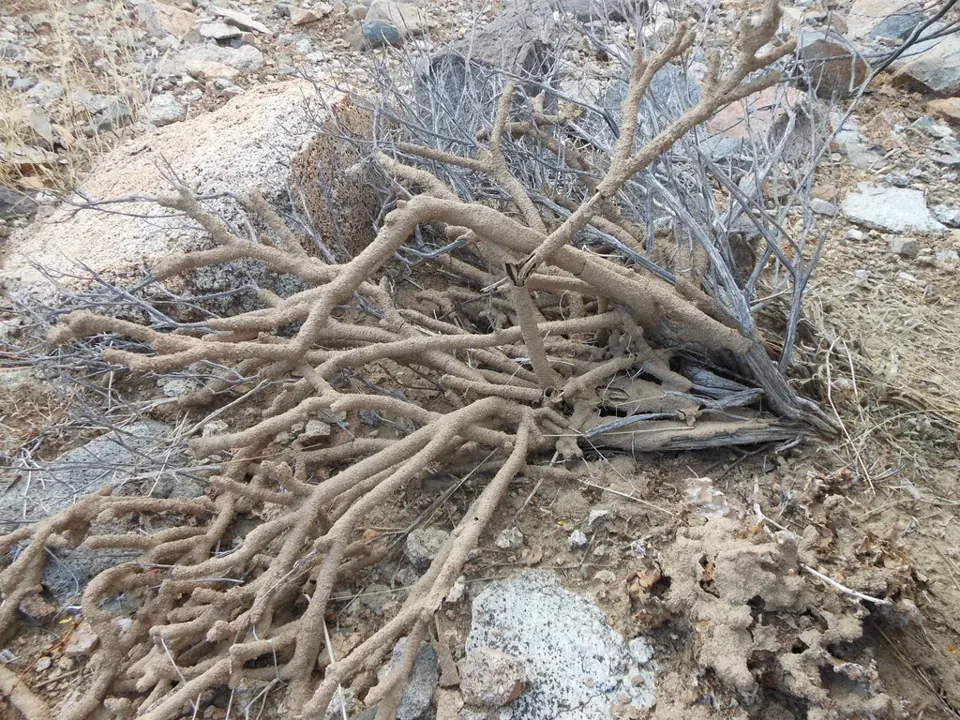
The desert subterranean termite (Heterotermes aureus) is a structural pest 2 whose tubes look different. They are small, strong, nearly airtight and circular in cross-section, lined with light yellow fecal material that gives them a pale color 11. Infested buildings can be identified by drop tubes hanging from the ceiling 11.
The arid land subterranean termite builds flatter, less solid tubes that look dirty dark brown 11. In Florida, Heterotermes tubes are lighter, narrower and rounder than those of Reticulitermes or Coptotermes, sometimes hanging free from ceilings 12.
In south Florida, the conehead termite (Nasutitermes corniger) builds hollow tunnels about 5 mm or wider, branching across trees and walls and looking like straw when broken 13. Sightings can be reported to the Conehead Termite Program of the Florida Department of Agriculture and Consumer Services 13.
Two groups build no tubes at all. Drywood termites nest in dry wood above ground without soil contact 2. Dampwood termites neither tunnel through soil nor build shelter tubes 14.
What to do when the tube is active
An active tube means subterranean termites. UC IPM notes that pesticide applications against them are highly regulated and require a licensed professional 2.
NC State does not recommend do-it-yourself chemical control 4. Its arithmetic shows the scale: a 40 by 30 foot house with its footer 1 foot below grade needs about 48 gallons along the outside foundation wall alone 4. Applying it means trenching and drilling to the footer with equipment few homeowners own 4.
The professional treatment options are a liquid termiticide applied to the soil around the foundation, or a bait system 84. Insecticide can also be applied directly to nests through the shelter tubes 2. Bait systems may take several months or longer to control the problem and need constant monitoring 2.
An above-ground colony changes the plan: NC State makes finding and correcting the moisture problem the first step 4.
Homeowners can correct conducive conditions on their own 2. Removing wood that touches the soil and keeping mulch off the siding close easy entry points, while fixing leaks and directing water away from the foundation remove the moisture 48.
The USDA Forest Service advises that extreme haste is not required once an infestation is found, though treatment should follow within a few months 1. In California, a termite inspection by a licensed professional is required before any treatment can be performed 2.
Questions
Should I break termite mud tubes?
Breaking a short section, about an inch, is the standard activity test. Termites in the break, or a repair over the next few days, confirm an active infestation 3.
What does an old termite mud tube look like?
Old tubes are dry and crumble easily. They often leave an etched trace on the surface that can stay visible for years 4.
What does it mean if mud tubes have no termites in them?
Not that the colony is gone. Termites regularly abandon tunnels and rebuild damaged ones, so an empty tube still calls for a professional inspection 43.
Sources
- Peterson, C., T. L. Wagner, J. E. Mulrooney, and T. G. Shelton. Subterranean Termites: Their Prevention and Control in Buildings. USDA Forest Service, Home and Garden Bulletin 64. Revised October 2006. research.fs.usda.gov
- Lewis, V. R., M. I. Haverty, and A. M. Sutherland. Pest Notes: Subterranean and Other Termites. UC ANR Publication 7415. UC Statewide IPM Program. Updated 05/2014. ipm.ucanr.edu
- Mississippi State University Extension Service, Dept. of Entomology. Signs of Termite Infestation. Year not stated. extension.msstate.edu
- Hayes, C. Monitoring and Management of Eastern Subterranean Termites. NC State Extension Publications. Publication date Jan. 22, 2025. content.ces.ncsu.edu
- Dugas, K. Eastern Subterranean Termite (Reticulitermes flavipes). Connecticut Agricultural Experiment Station fact sheet. Year not stated. portal.ct.gov
- Basnagala, S., T.-Y. Lee, and K. I. Perry. Eastern Subterranean Termite, Reticulitermes flavipes. Buckeye Yard and Garden onLine (BYGL), Ohio State University. Published May 13, 2024. bygl.osu.edu
- Texas A&M University, Urban and Structural Entomology Program. Native Subterranean Termites, Reticulitermes sp. (web page). Year not stated. urbanentomology.tamu.edu
- Oi, F. M., J. Davis, J. McConnell, J. Corbus, N. Nelson, and M. Atkinson. Termite Prevention and Control. UF/IFAS Extension ENY-2044 (IN1277). Original March 2020; revised December 2023. ask.ifas.ufl.edu
- LSU AgCenter, LSU Department of Entomology, and Louisiana State Arthropod Museum. Insect Identification Services. LSU AgCenter Publication 1838. Year not stated. www.lsuagcenter.com
- Baker, P. Termite Management for Homeowners. University of Arizona Cooperative Extension AZ1356 (dated 3/2005). extension.arizona.edu
- Baker, P. B., and R. J. Marchosky, Jr. Arizona Termites of Economic Importance. University of Arizona Cooperative Extension AZ1369. June 2005. extension.arizona.edu
- Scheffrahn, R. H., and N.-Y. Su. West Indian Subterranean Termite, Heterotermes sp. UF/IFAS EDIS EENY127 (IN284). Original April 2000; revised December 2005; reviewed February 2021. ask.ifas.ufl.edu
- Tong, R. L., K. E. Tenn, and R. H. Scheffrahn. Conehead Termite, Nasutitermes corniger. UF/IFAS EDIS EENY-745 (IN1275). Original December 2019. ask.ifas.ufl.edu
- Cannings, R. A., and G. G. E. Scudder. Families of Isoptera of British Columbia. In: Klinkenberg, B. (ed.) 2023. E-Fauna BC: Electronic Atlas of the Fauna of British Columbia. Dept. of Geography, University of British Columbia. linnet.geog.ubc.ca
- Gordon, J. M., R. H. Scheffrahn, and N.-Y. Su. West Indian Drywood Termite, Cryptotermes brevis. UF/IFAS EDIS EENY-79 (IN236). Original April 1999; revised December 2025. doi:10.32473/EDIS-in236-2020. ask.ifas.ufl.edu