Carpenter ants vs termites
Workers, debris and damage compared, with the treatment each insect needs.
Carpenter ants are large, dark ants with elbowed antennae and a narrow waist bearing one node 1. Termite workers are pale, soft-bodied and rarely seen in the open 2. Carpenter ants do not eat wood. They push out coarse, fibrous sawdust and leave clean, smooth galleries, while subterranean termite galleries are lined with mud 1.
Outdoors, carpenter ants and termites both do useful work. Carpenter ant nests in dead trees and stumps help wood decompose 3. Termites break down cellulose into material that returns to the soil as humus 4.
Indoors, the same habits hollow out framing, trim and door frames 15. Both insects are also drawn to the same damp corners of a house 14.
Perhaps you pulled off trim during a repair and found hollowed wood, or a small pile of sawdust keeps reappearing under a window frame.
But these two insects need completely different treatment. Texas A&M AgriLife Extension states that control measures differ greatly between them, and that treatments for termites will not control carpenter ants 1.
So which insect hollowed out that wood? We compared the insects, the debris and the galleries using extension descriptions from Texas, California and the USDA Forest Service.
Two very different insects once you look closely
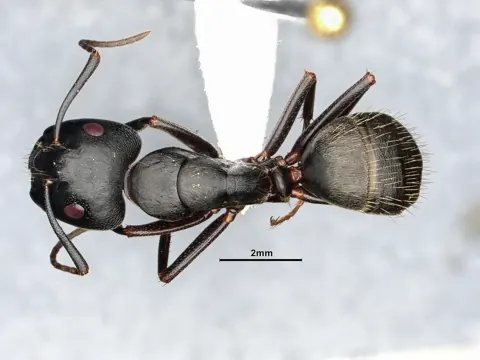
Carpenter ants are among the largest ants in North America 3. Texas A&M gives worker lengths of about 1/4 to 5/8 inch 1, while UC IPM gives 1/4 to 1/2 inch for the two most destructive western species 3. They can be yellowish red, solid black, or a mix of black, red and reddish orange 1.
Unlike other ants, a carpenter ant has only one node on its narrow waist and a circle of hairs at the tip of the abdomen 1. Seen from the side, its thorax is evenly rounded, with no spines or bumps 1.
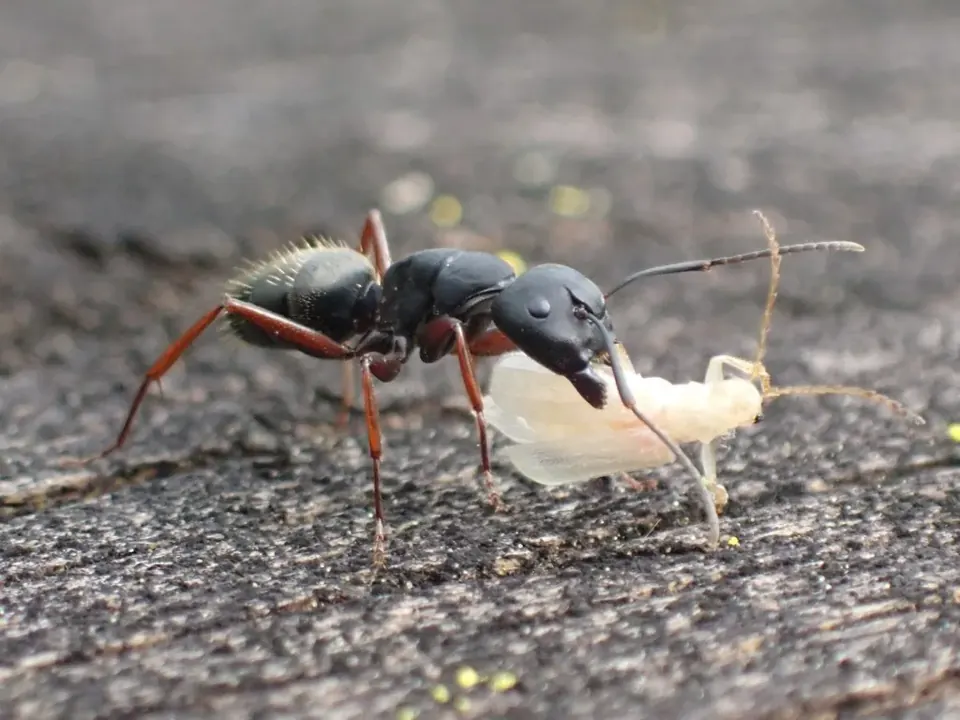
Like all ants, carpenter ants have antennae bent at a right angle about midway 1. They cannot sting, but they can bite and spray formic acid into the wound 3.
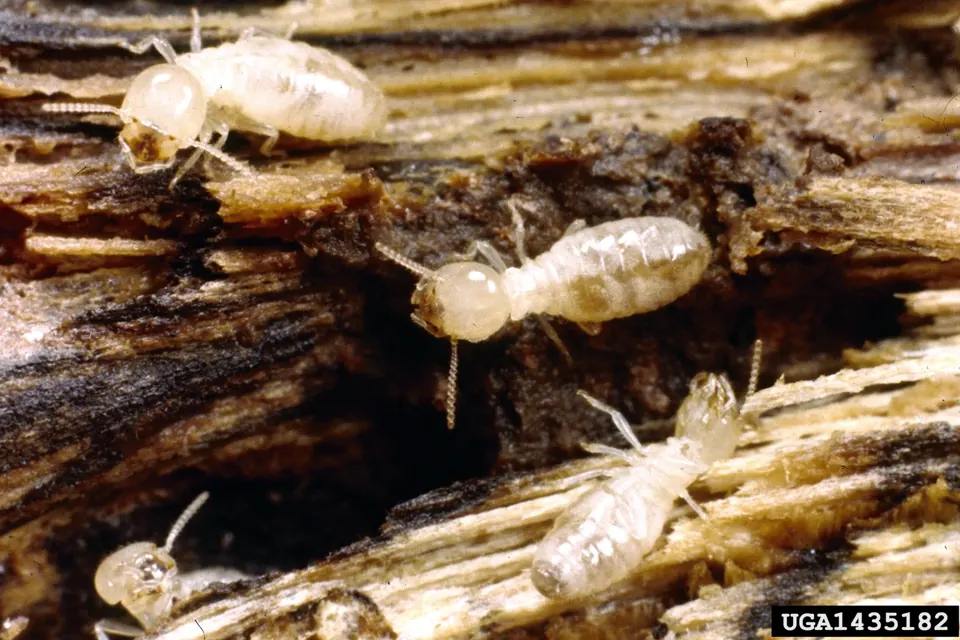
Termite workers share none of these features. They are wingless, soft-bodied, white or yellow-white 2 and blind 6. Subterranean termites are almost never seen foraging in the open 2.
Carpenter ants, by contrast, forage mostly at night 1. They follow fence rails, tree branches, garden edging and water hoses to travel from a nest in a tree to indoor food 1.
Carpenter ants dig, while termites eat
Carpenter ants hollow out wood or insulation to build their nests, but unlike termites they cannot digest cellulose and do not eat the wood 1. Their diet is mostly insects, honeydew from plant-sucking insects, sweets and meat 1.
Termites do eat the wood. Most subterranean species rely on protozoans and bacteria in their hindgut to help digest cellulose 4. Within the colony, the worker caste chews the wood and causes the damage 4.
That difference changes treatment. Boron-salt wood treatments are toxic to insects that feed on the wood, so they do not control carpenter ants, which never ingest it 1.
What falls out of the wood tells you who is inside
Carpenter ants carry dead insects, shredded wood fragments and other nest debris out of their galleries 1. Cone-shaped piles of this frass build up beneath nest openings 1. Looking closely above a pile often shows the "kick-hole", a tiny opening where the ants drop debris from the nest 1.
UC IPM describes carpenter ant sawdust as fibrous 3. The frass is not always visible, because ants may dump it inside hollow trees, unused galleries or wall voids 1.
Drywood termites leave hard, six-sided fecal pellets instead 3, which pile up below kick-out holes 1 to 2 mm across 7. A University of Hawaii handout compares these termite droppings to fine grains of sand 8.
Subterranean termites push nothing out at all. They do not reduce wood to powder or push particles outside, as beetles and carpenter ants do 2. Their signs are mud instead, in the form of earthen shelter tubes and moist soil carried into the wood 4.
Inside the wood: clean galleries or mud-lined ones
Opened wood gives the clearest answer. Carpenter ants excavate along the grain, removing the softer, lighter-colored spring wood and leaving galleries that are clean and smooth 1.
Subterranean termite galleries also follow the grain and the soft spring growth 4. The difference is the lining. Termite tunnels are lined with mud or have a pale, spotted look from soft fecal material plastered on the surface 4. The USDA Forest Service describes yellow-brown or gray specks of excrement and soil 2.
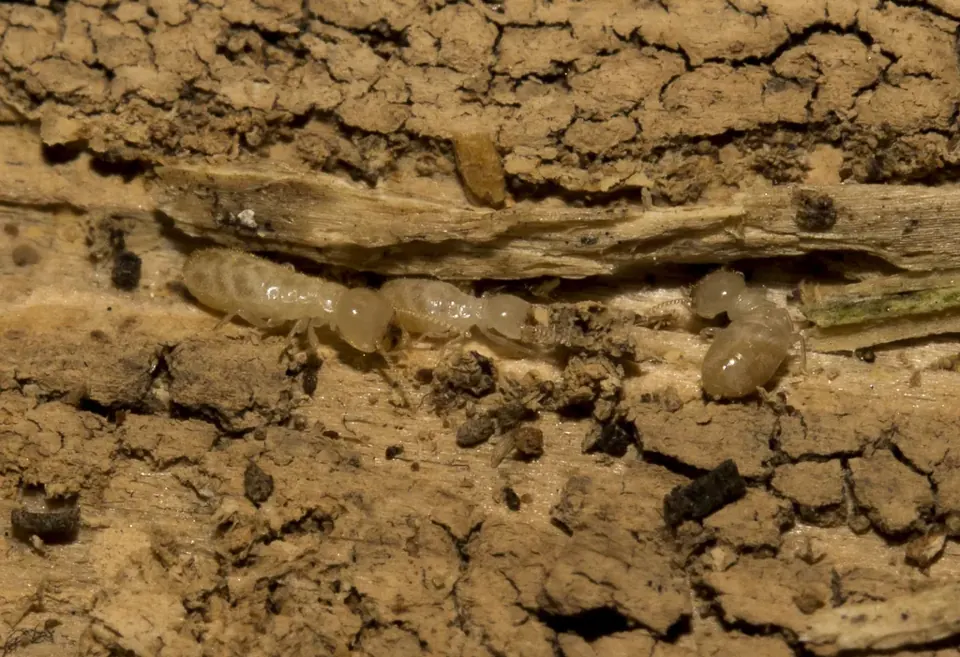
Mississippi State University Extension puts it plainly: damaged timber with galleries containing dried dirt is termite damage 9. Drywood termite galleries are a third pattern, cutting across the grain and holding pellets rather than mud 85.
Before any wood comes off, severely damaged pieces may sound hollow when tapped 2. Prodding with a screwdriver shows whether a suspect piece is sound, which matters because termite damage is often not noticeable on the surface 2.
Moisture: what draws both insects to the same wood
Carpenter ants nest in wood that is moist or has been damaged by water or termites 1. Leaks, condensation and continuously high humidity create those spots 1. Colony growth in some species also rises with moisture, which may explain why nests are more common in wetter wood 1.
Typical carpenter ant nest sites include wood around plumbing leaks in kitchens and bathrooms, wood in contact with soil, and window and door framing 1. UC IPM notes that large nests often begin in an area with water damage or wood decay before expanding into sound wood 3.
Subterranean termites depend on moisture just as much. They have little resistance to drying out and need contact with soil or an above-ground source such as defective plumbing, a leaky roof or poorly maintained gutters 4. Dampwood termites go further and live only in wet or decaying wood 10.
The two insects can even share a board. Carpenter ants often nest in wood that termites have already damaged 1, so finding one insect does not rule out the other.
Winged carpenter ants and winged termites
Mature carpenter ant colonies produce 200 to 400 winged reproductives a year 1. These develop in late summer, spend the winter in the nest and swarm in spring and early summer 1. Winged carpenter ants can reach 3/4 inch 1.
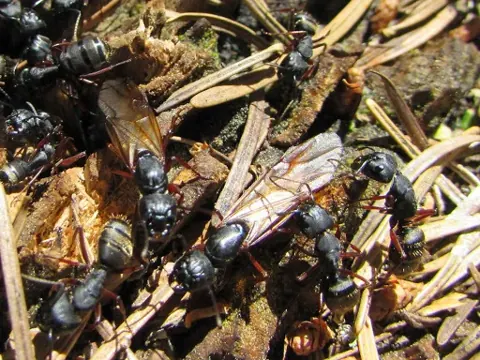
Their wings give them away. Carpenter ant front wings are longer than the hind wings, while termite wings are of equal length 1. Wing length is one of four checks that separate flying ants from termites, along with antennae, waist and wing stubs.
What to do about carpenter ants
The key to managing carpenter ants is finding every place a colony could be, inside and outside 1. Conical piles of shredded wood point to a nearby nest 1. Carpenter ants may travel as far as 100 yards from the nest to food 1. Following foraging workers after sunset, when they are most active, is one of the best ways to find the nest 3.
UC IPM suggests a nontoxic bait, such as sugar mixed with milk or diced crickets, to attract foragers before following them home 3. Looking and listening for sawdust, frass and a faint rustling in walls also helps 3.
Once the nest is found, treatment can take several forms 13:
- Nest treatment. An insecticide dust, aerosol or foam applied directly into the nest galleries is one of the most effective methods 1. Drilling 1/8-inch holes may be needed to reach hollow doors, wall voids or frames 1.
- Baits. Slow-acting baits work best, because foragers carry them back to the nest. Only about 10 percent of the ants forage at any one time 3. Texas A&M advises carpenter-ant-specific gel or granular baits rather than general containerized ant baits 1.
- Products that fail. Boric acid dust is not an effective product for carpenter ants 1.
- Moisture and access. Fixing leaks, replacing decayed wood, keeping soil off structural wood and trimming branches that touch the house all reduce infestations 13.
The scale of the response depends on the region. In Texas, where carpenter ants rarely cause significant structural damage, a few workers may not justify an expensive treatment program 1. A pending real estate sale, on the other hand, may justify an aggressive effort, because Texas treats carpenter ants as a potential wood-destroying organism 1.
What to do about termites
Termites call for a professional inspection, because the colony is usually hidden 9 and treatment depends on the termite group 5. A termite inspection also checks whether the infestation is still active.
For subterranean termites, the two main approaches are non-repellent liquid termiticides and baits, applied by a licensed pest management provider 11. Drywood termites are treated with spot treatment after a thorough inspection, or with fumigation 5. Drying the infested area is usually enough to control dampwood termites 5.
Each route to get rid of termites starts from the group, because UF/IFAS describes the treatments for different termites as drastically different and most of them costly 5.
Questions
Which is worse, carpenter ants or termites?
Termites usually do more harm: Purdue Extension calls ants a nuisance and termites destructive 12. Large carpenter ant colonies can still weaken a structure when they expand their nests into sound wood 3.
Do carpenter ants eat wood?
No. Carpenter ants excavate wood to build their nests but cannot digest cellulose 1.
Can a house have carpenter ants and termites at the same time?
Yes. Carpenter ants often nest in wood that termites or water have already damaged 1.
Will a termite treatment get rid of carpenter ants?
Usually not. Texas A&M AgriLife Extension states that treatments for termites or other pests will not control carpenter ants 1.
Sources
- Brown, W., and R. E. Gold. Carpenter Ants. Texas AgriLife Extension Service, E-412 (dated 12-11). agrilifeextension.tamu.edu
- Peterson, C., T. L. Wagner, J. E. Mulrooney, and T. G. Shelton. Subterranean Termites: Their Prevention and Control in Buildings. USDA Forest Service, Home and Garden Bulletin 64. Revised October 2006. research.fs.usda.gov
- Klotz, S. A., L. D. Hansen, and M. K. Rust. Pest Notes: Carpenter Ants. UC ANR Publication 7416. UC Statewide IPM Program. Updated 08/2009. ipm.ucanr.edu
- Texas A&M University, Urban and Structural Entomology Program. Native Subterranean Termites, Reticulitermes sp. (web page). Year not stated. urbanentomology.tamu.edu
- Oi, F. M., J. Davis, J. McConnell, J. Corbus, N. Nelson, and M. Atkinson. Termite Prevention and Control. UF/IFAS Extension ENY-2044 (IN1277). Original March 2020; revised December 2023. ask.ifas.ufl.edu
- Dugas, K. Eastern Subterranean Termite (Reticulitermes flavipes). Connecticut Agricultural Experiment Station fact sheet. Year not stated. portal.ct.gov
- Gordon, J. M., R. H. Scheffrahn, and N.-Y. Su. West Indian Drywood Termite, Cryptotermes brevis. UF/IFAS EDIS EENY-79 (IN236). Original April 1999; revised December 2025. doi:10.32473/EDIS-in236-2020. ask.ifas.ufl.edu
- University of Hawaii, CTAHR Termite Project. Drywood Termites vs. Subterranean Termites (public handout, PDF). Year not stated. www3.ctahr.hawaii.edu
- Mississippi State University Extension Service, Dept. of Entomology. Signs of Termite Infestation. Year not stated. extension.msstate.edu
- Cannings, R. A., and G. G. E. Scudder. Families of Isoptera of British Columbia. In: Klinkenberg, B. (ed.) 2023. E-Fauna BC: Electronic Atlas of the Fauna of British Columbia. Dept. of Geography, University of British Columbia. linnet.geog.ubc.ca
- Chouvenc, T., N.-Y. Su, and R. H. Scheffrahn. Native Subterranean Termites: Reticulitermes flavipes, R. virginicus, R. hageni. UF/IFAS EDIS EENY-212 (IN369). Original May 2004; revised July 2024. doi:10.32473/edis-in369-2001. ask.ifas.ufl.edu
- Gibb, T. J. Finding Winged Termites Is a Red Flag. Purdue Extension Hot News HN-61-W. Dated 5/15/2009. extension.entm.purdue.edu